The feature guide
Each card is one feature of the app, said in a sentence, with links to the pages that go deeper. A card with no links has no page yet. If the app does something you can't find here, tell whoever runs your LifeOps.
Getting inYou reach your LifeOps at one web address, or from its phone apps
Claim a new account
A LifeOps nobody has signed into yet opens with a form that makes the account rather than asks for one: a username, a password of at least twelve characters, and the same password again. It works once, and that password cannot be reset by anyone, so keep it somewhere you trust.
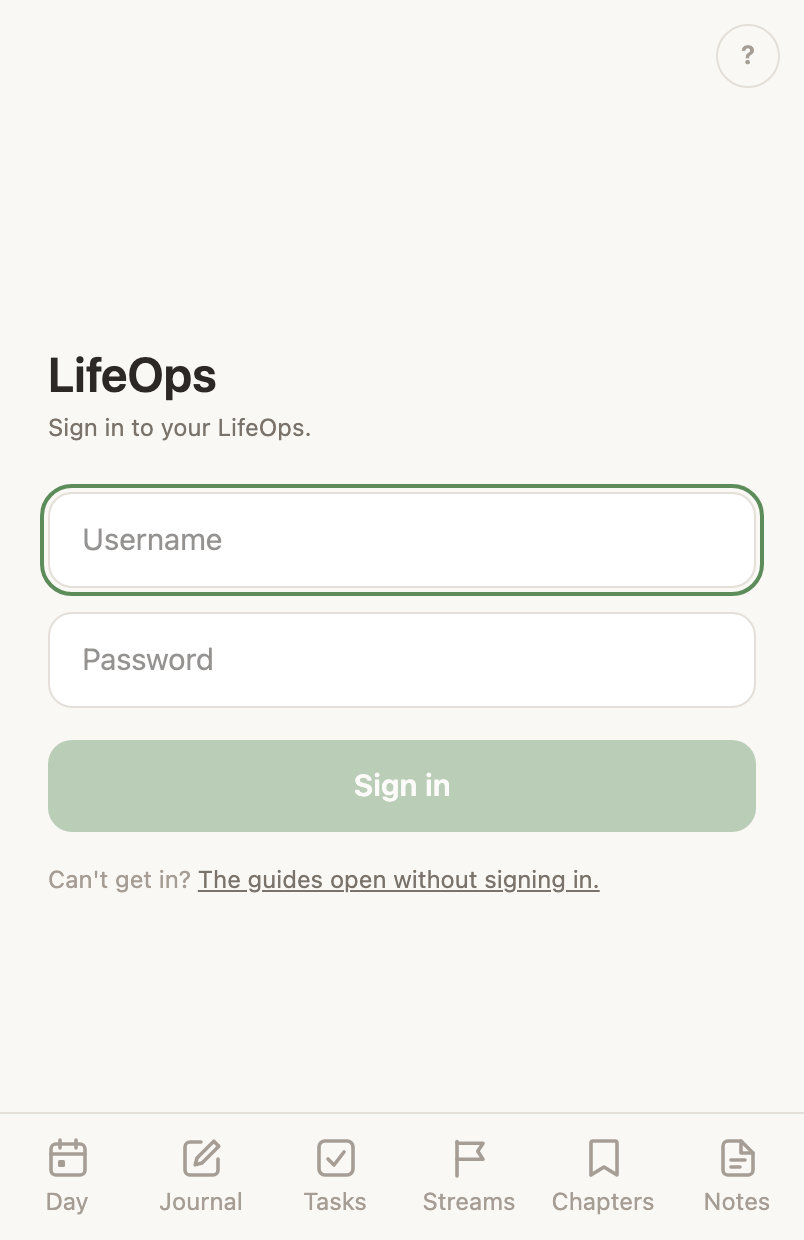
Sign in to your account
Your LifeOps is at one web address, with one username and password. A refusal says the username and password were not accepted, and never which of the two was wrong. Five wrong tries lock sign-in for fifteen minutes.
One counter, two doors
Wrong passwords at the sign-in page and wrong current passwords at the change-password form count toward the same fifteen minutes. Five at either door closes both.
A session that runs out over your work
When a session expires while you are on a page, a sign-in box opens over your work instead of throwing you back to the sign-in page, and nothing you have typed is lost. Opening a new page on an expired session does go to sign-in.
Signing in finishes the trip
A page you asked for while signed out opens once you sign in, rather than dropping you on the Journal. Anything that is not a page of this app is discarded rather than followed.
Make a token for your phone
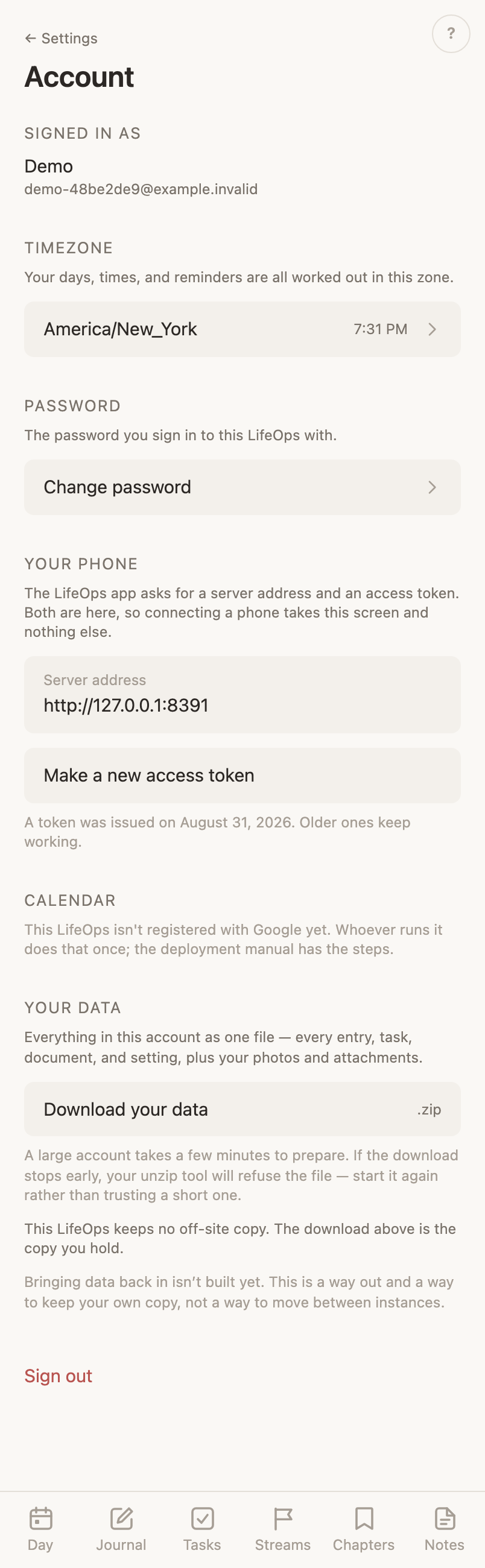
Settings on the web shows the server address and mints the phone’s token, so you do this yourself rather than asking anyone. The token is shown once and only its fingerprint is kept. Making a new one does not stop the old ones: a phone already connected stays connected, and the screen says so as it hands you the new token.
Connect the phone app
The phone app takes the server address and the token. It stores them in the device’s keychain, checks the connection before it saves anything, and then shows who it connected as.
The phone says when it cannot reach the server
A strip across the top says which it is: the server is updating, or the network is gone. It retries a few times before saying anything at all, and says Back online and re-reads your day once the server answers again.
The phone app takes most changes without a new build
A change that is only JavaScript — a screen, a wording, a rule the app follows — reaches an installed phone app without a store, a build or anything for you to install. The app asks for one each time it opens, downloads it in the background, and runs it the next time you open the app, so the open that fetches an update still shows you the old version. Anything native still takes a full build: a permission, the icon, a new capability. A build only takes updates stamped with its own version, and version 1.7.0 is the first build with the updater in it at all.
The phone apps
The iPhone app is handed out through TestFlight, and the App Store comes later. The Android app is built and not handed out yet. The web app is the way in for everyone either way, on a phone as well as a laptop.
JournalYou write the day down as it happens
Where to start
A new LifeOps opens with three things to do: write a line, name a life area, add a task. Each ticks off as you do it, and Put this away closes it for good.
The capture bar
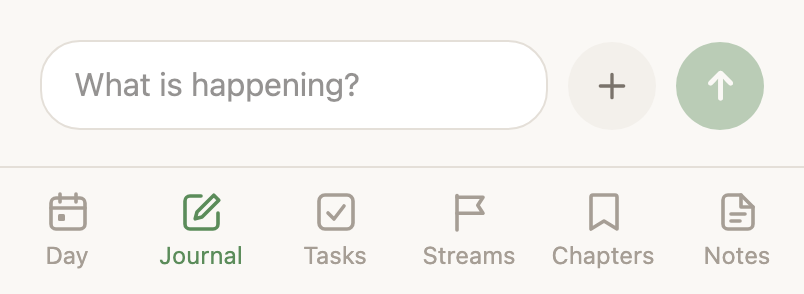
The bar at the bottom of the screen reads What is happening?, and your entry goes into the day at the minute you send it. On an earlier day it saves to that day with no time.
Sending an entry from the capture bar
Enter sends it. Shift and Enter break the line instead, and the box grows as you write until about a paragraph, where the pen takes over.
Hold ↑ to time an entry
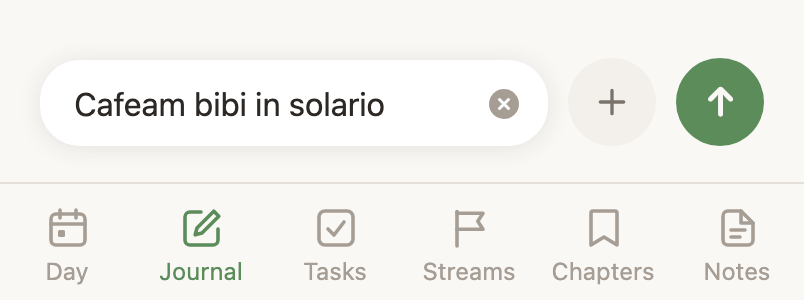
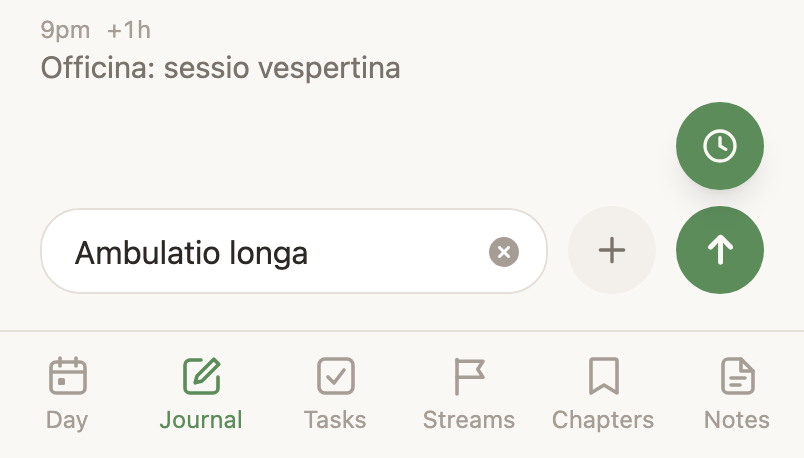
Hold the send arrow and the entry starts as a running time log. Tap its Stop when you finish. Only today can be timed, and only one time log runs at a time, so starting a second closes the first.
The day’s feed
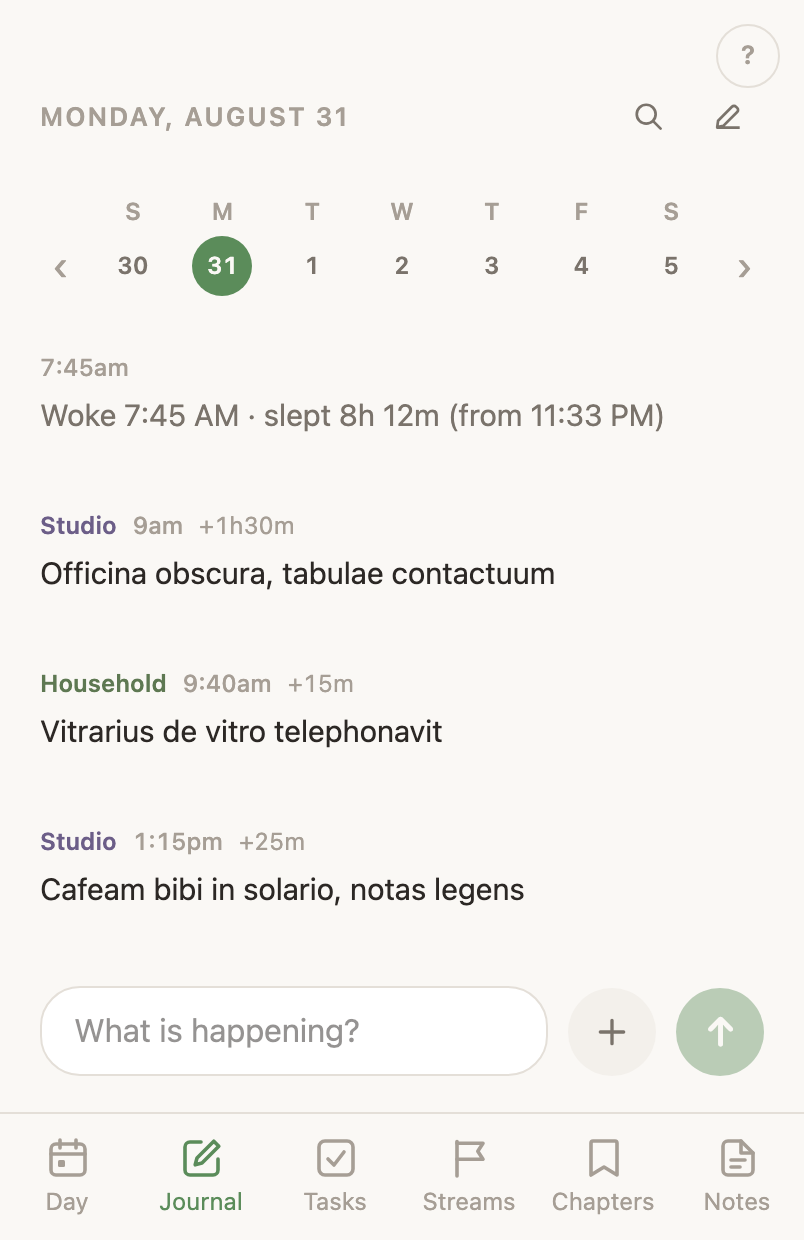
The feed is your day read top to bottom. Each entry shows its time, its life area’s colour, and its length when it has one. An entry with no time of day shows a dash instead.
Meetings in the feed
Your meetings appear in the feed at their times, and the rest of today’s come under Upcoming. Hold one for the same three words the Day uses: Going, which marks it Going beside its time, Done, which turns it into a time log, and Decline, which comes off the day and answers no in Google, emailing nobody, after six seconds in which Undo takes it back. A meeting you declined in Google never reaches the feed.
The entry menu
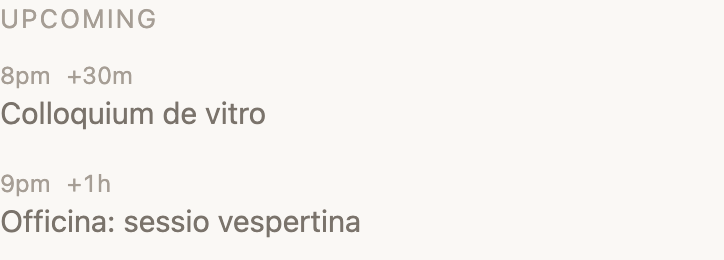
Right-click an entry on a laptop, or hold it on a phone. The menu edits the words, changes its life areas, retimes it, links it to a task, or deletes it. A long-form entry has no Edit there. Its words belong to its document.
Undo stands for six seconds
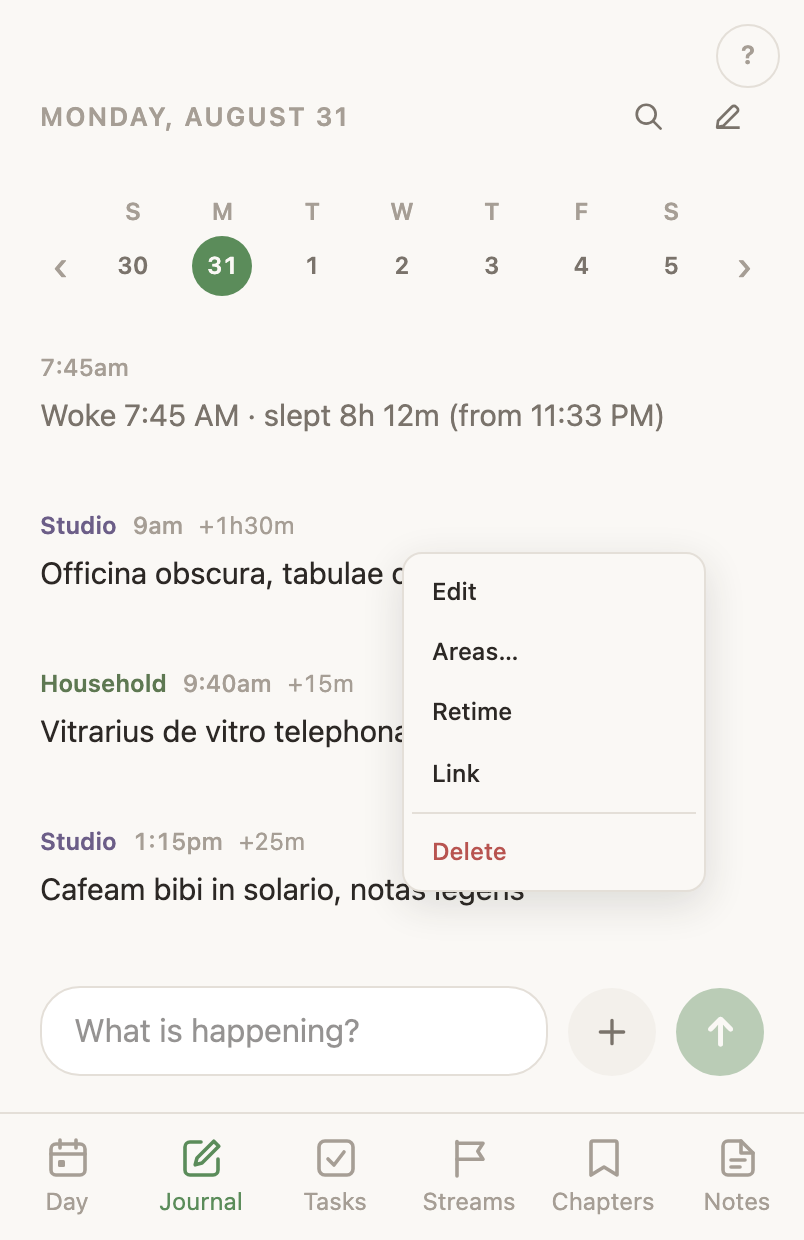
Deleting an entry, and declining a meeting, both leave an Undo on screen for six seconds. Press it and the entry comes back whole, or the meeting keeps its place. The app waits out the six seconds before it sends anything.
Retime an entry
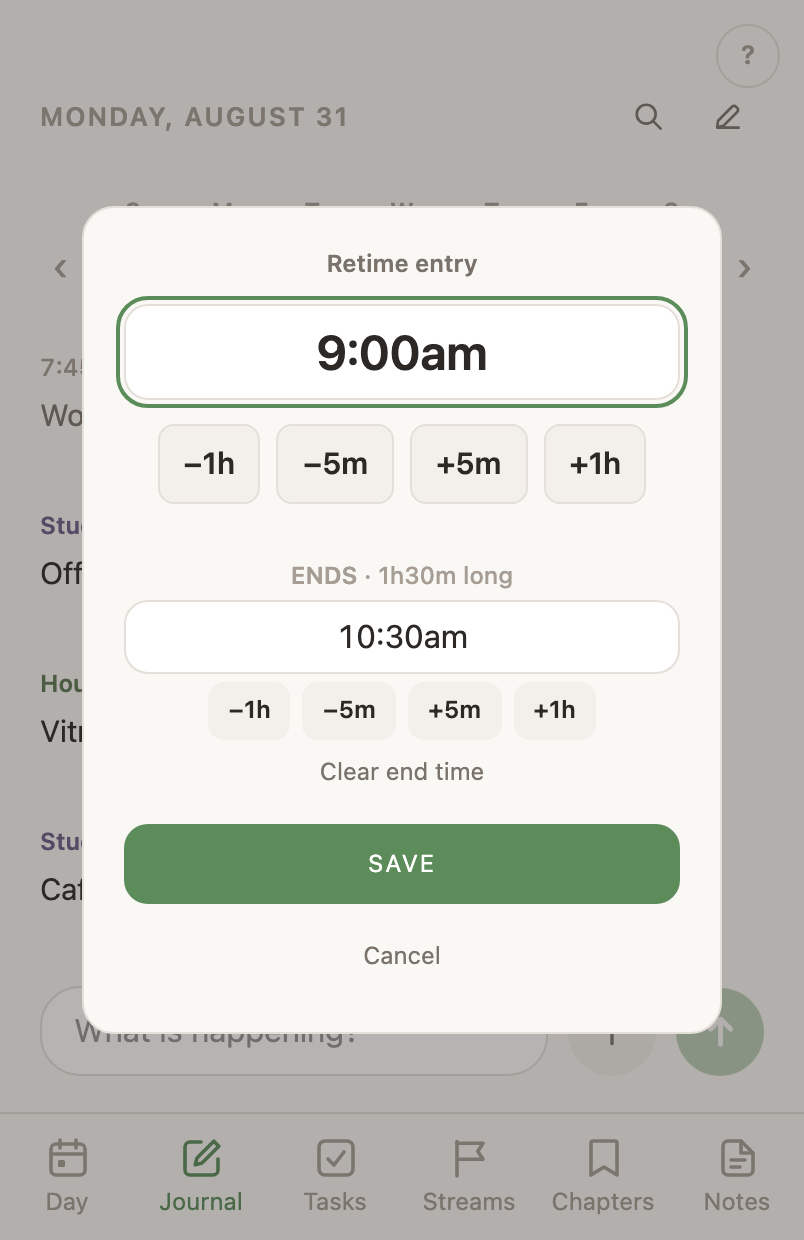
Retime moves an entry to another time on the same day, nudged five minutes or an hour at a time. Give it an end and the moment becomes a time log.
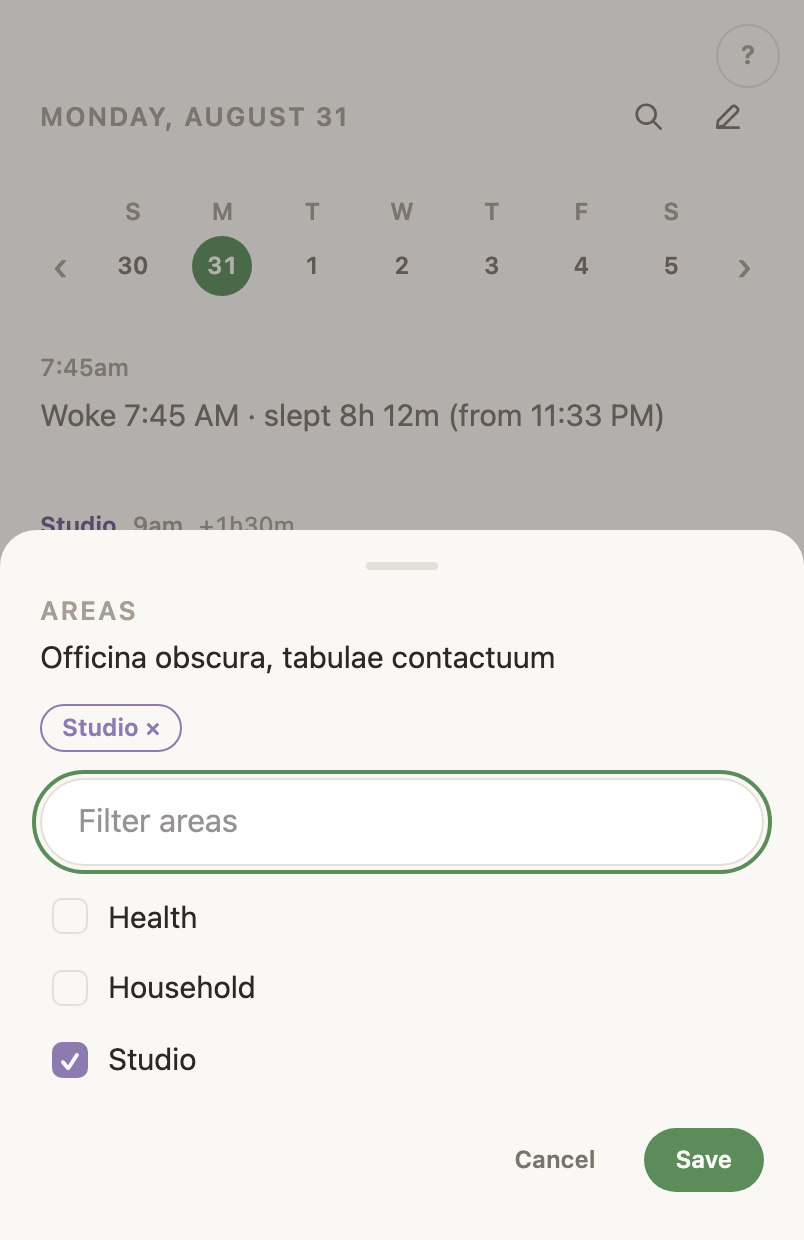
Life areas on an entry
An entry belongs to the life areas you pick, and the first pick sets its colour. The picker filters as you type. Clear them all and the entry stays as you left it. The AI files an entry once at most, and never returns to one it has answered.
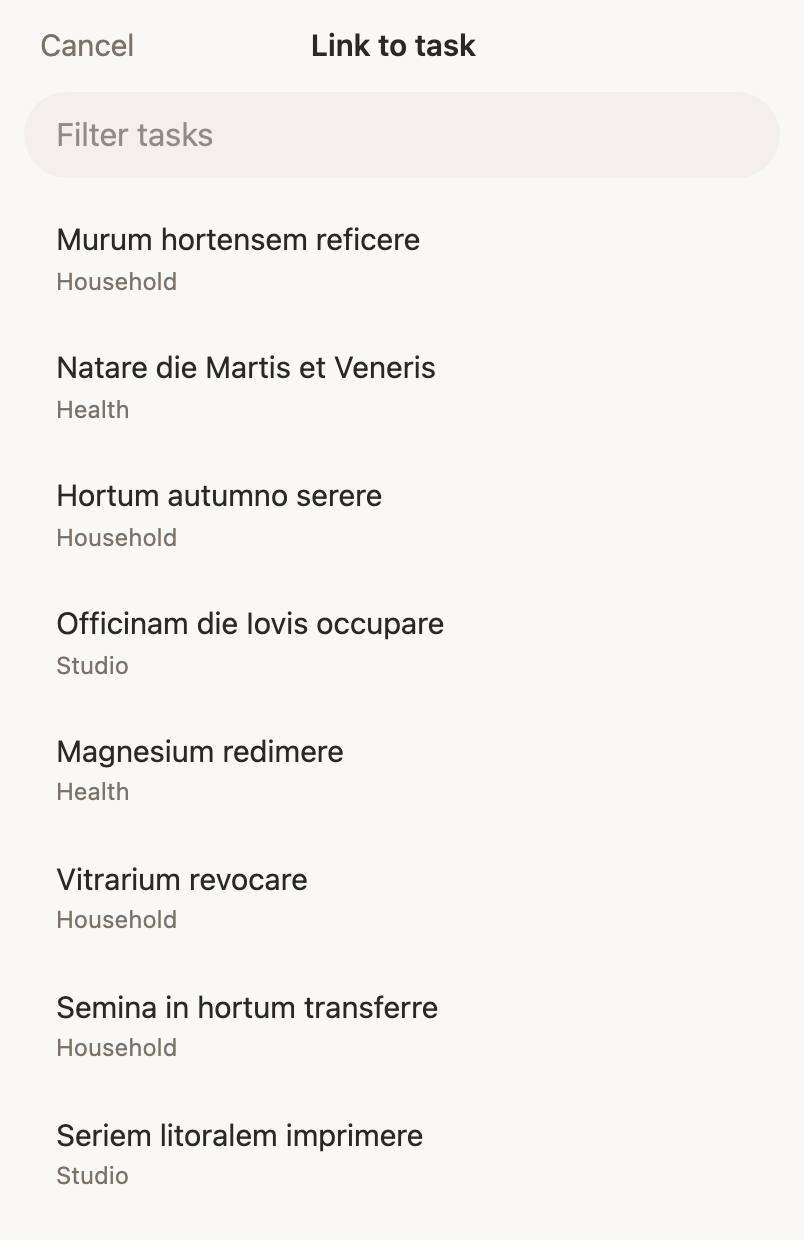
Link an entry to a task
An entry linked to one of your open tasks takes that task’s life area, so your log and your work line up. The same picker offers Unlink, which returns the entry to standing on its own.
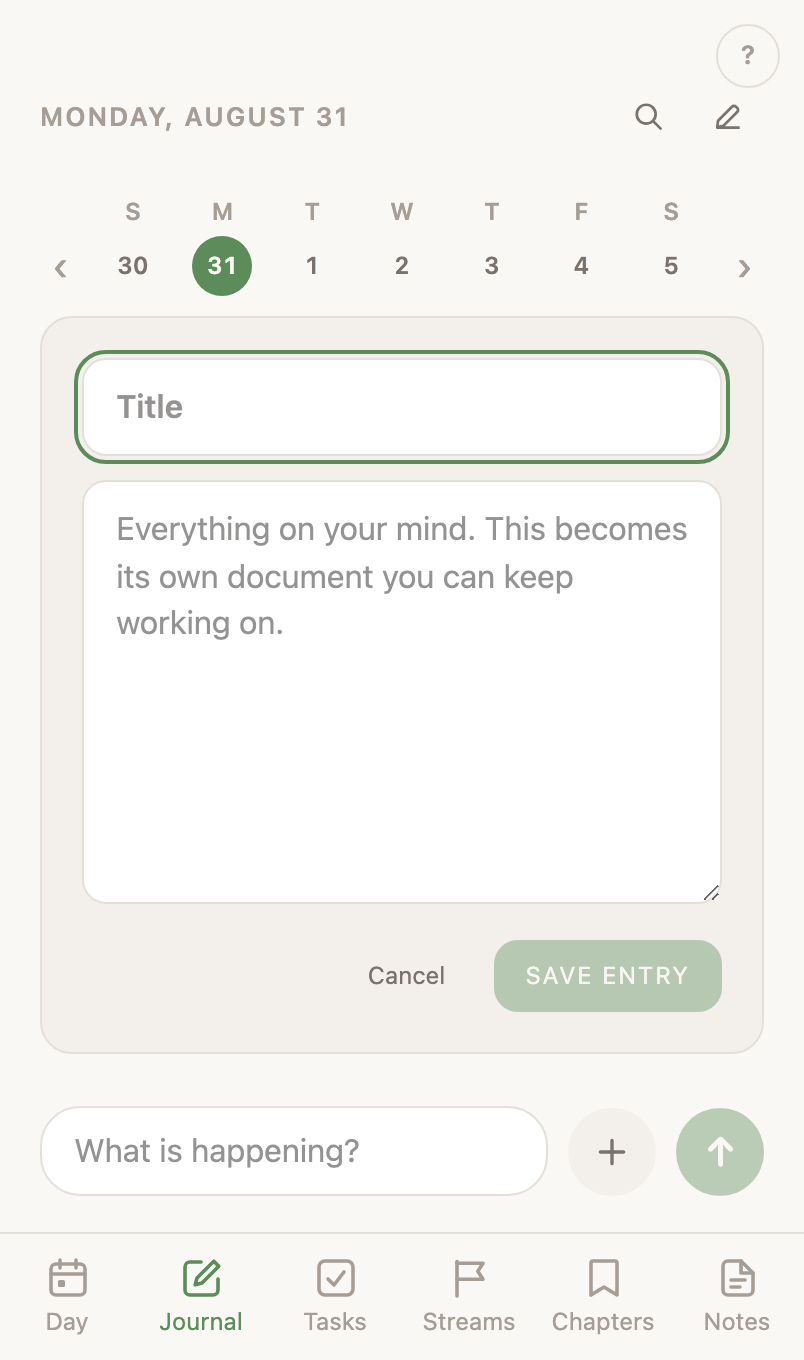
Long-form entries
Tap the pen to write an entry longer than one line. Give it a title and it becomes a document as well, and its entry in the feed opens it.
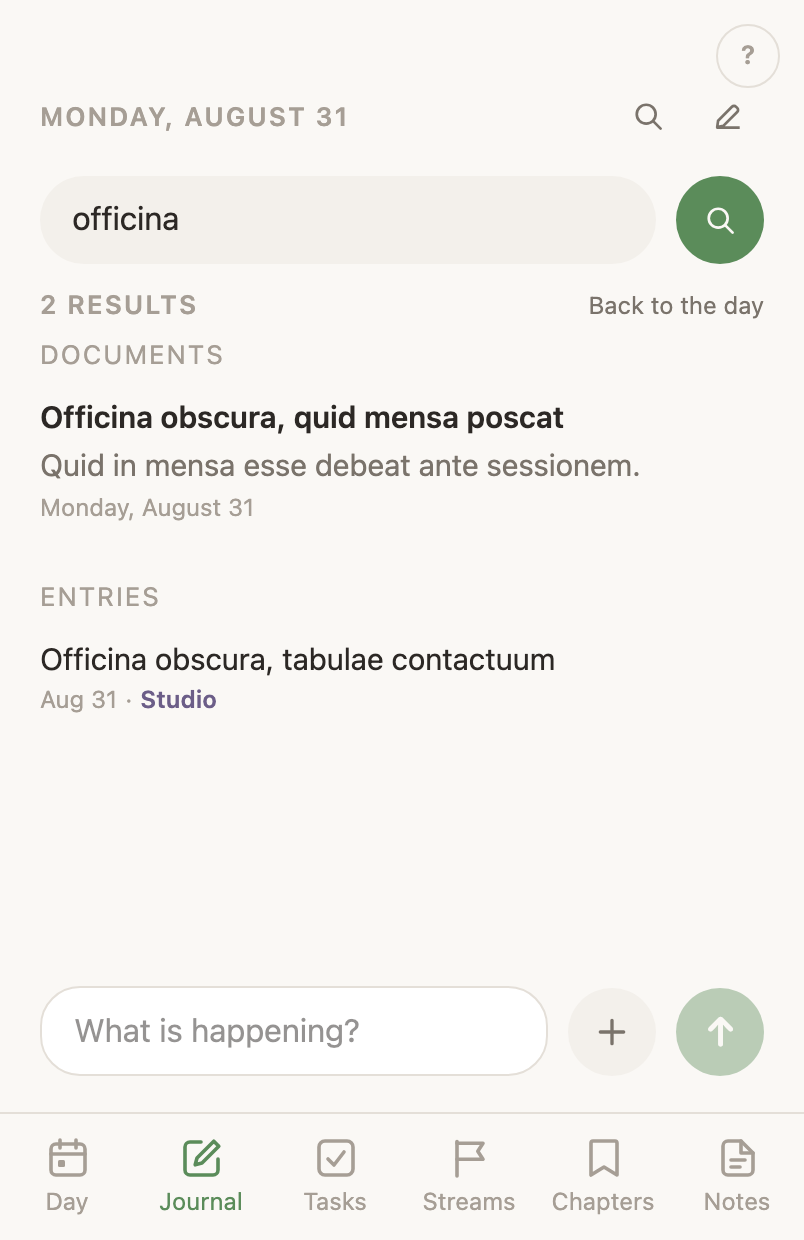
Journal search
One search covers every day you have written on and the text inside your documents. Results come back grouped, documents then entries, and a result opens the day you wrote it on.
The week strip
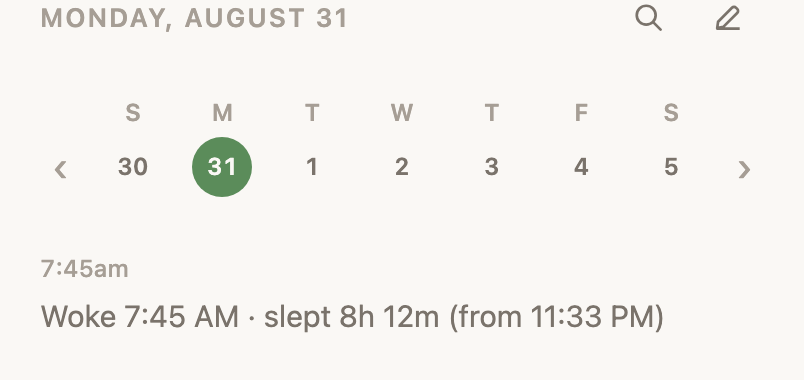
The week strip above the feed opens any day in the week shown, and the arrows either side move a day at a time. Step off either end and the strip follows, showing the week the new day is in. Today is one tap away when you leave it.
Photos and videos in the feed
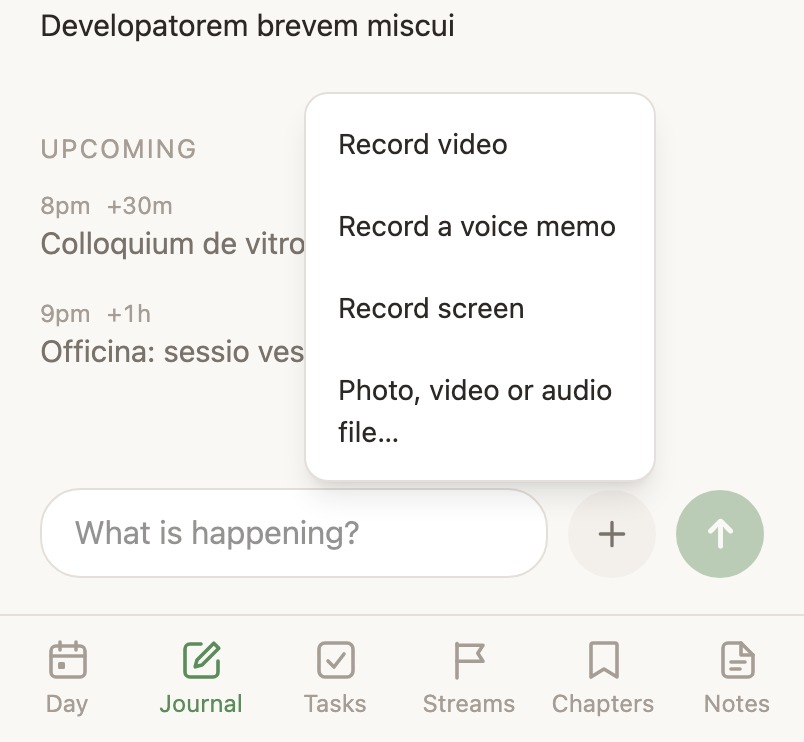
The + button beside the bar records a video, records a voice memo, records your screen, or attaches a photo, video or audio file from your device, and the result posts into the feed. A photo opens full size, and a video plays where it sits, in its own shape. Screen recording is on the web only.
Record a voice memo into the journal
Record a voice memo in the plus menu opens the recorder with the camera shut, for a journal update you don’t want your face in. It rolls on open, the clock and the level bar show it running, and the entry plays where it sits. It is transcribed on the same switch a video is. Web and phone both.
Your device keeps the take until it uploads
A take is saved on your device before it uploads. One that fails reappears after a restart, with Retry to send it again. The web can also write it to disk with Save file, and the phone hands it to the share sheet.
A long recording uploads in pieces
Anything over about eight megabytes goes up in pieces of that size, each sent on its own and tried again on its own, with a real percentage as it climbs. A connection that drops near the end costs the piece it was on rather than the whole take. The browser and the phone app both do this.
Every action on an entry answers a screen reader
The entry menu opens on a hold, and a hold is the one gesture a screen reader cannot make, so each row also declares Entry actions as an action the reader can perform. Edit, Areas, Retime, Link and Delete are reachable that way. The week strip and a meeting row answer the same way.
Transcripts and summaries
A recording’s words belong to its entry. The feed shows the title and summary, tapping them opens the full transcript in its own reader, and search reads the words. Recordings brought in from an earlier system keep the transcripts they arrived with. New ones are transcribed when Transcribed recordings is switched on, and a video is compressed in the background either way so it plays in the browser.
Correcting the sleep entry
The sleep entry’s menu has Correct sleep: say when you woke and when you fell asleep, nudged or typed, and the night’s length follows as you go. Editing its words changes nothing. The reading is a number, not a sentence.
Signal and System rows stay off the journal
The journal holds what you wrote. Your devices’ reports and the app’s own bookkeeping belong to the Day instead, and search leaves them out too.
Entries with no time collect under the day
An entry written while you were looking at another day has no place on the clock, so it collects under the day’s timed entries in the order you wrote it.
Task comments stay on the task
Something you type on a task belongs to that task. It stays off the feed, out of search, and off the Day.
Features you switch onThe parts that run on a service you pay for
A journal recording is transcribed
A video or a voice memo posted to the journal comes back with a title, a short summary and a readable transcript. The recording goes to ElevenLabs for the transcript. The transcript alone then goes to Anthropic, which writes the title and summary. Anything typed beside the recording is kept as written.
Off until you switch it on, and it needs a key
Anything that spends money at an outside service is off by default and needs two things to run: the switch, and a key. A switch turned on with no key says which one is missing. A key is stored for your account, never shown again, and removed by saving an empty field.
TasksTasks holds everything open, grouped by life area
Statuses, types, the extra views and the fuller task sheet come with the Streams & task detail switch.
Your areas
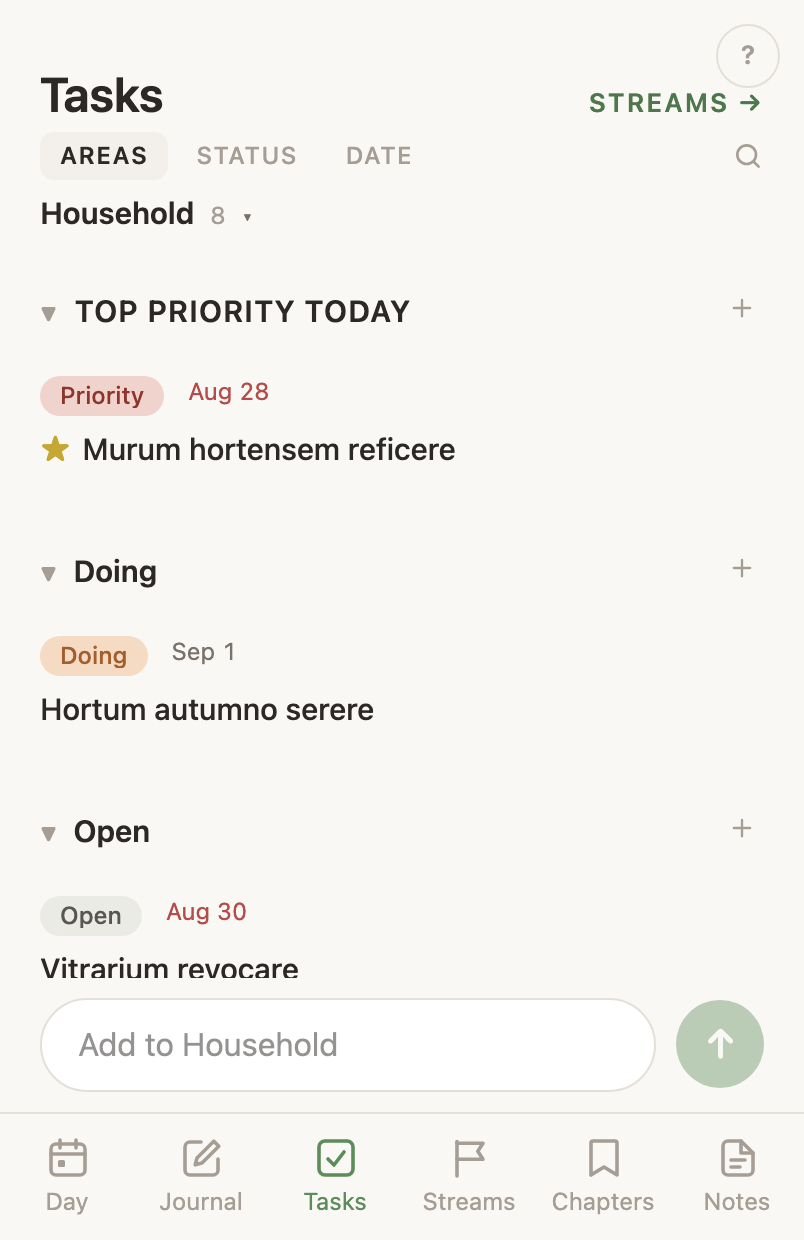
The Areas view shows one life area at a time. On a narrow screen the name at the top says which one, with its count beside it, and tapping that name lists your areas to switch between them. On a wide screen every area stands in a column down the left, each with its count and the busiest first, with All areas at the foot. Inside an area the tasks split under their status words. General holds the tasks with no area, and the add bar names the area you are in, so what you write there joins it.
A task with no life area is filed for you
With AI on, a background sweep reads an open task that has no life area and files it under one of yours, from the task’s words, its kind and its note. A task it cannot place stays under General, and it is asked about again the next time you add, rename or remove a life area — the list it was choosing from has changed. A task you filed yourself it never touches. Your pick always replaces its own, and clearing a task’s area keeps it clear.
A task under a stream takes that stream’s area
When the stream a task belongs to has a life area, the task takes it, and no model is asked. That makes it a rule rather than a guess, so it holds with AI switched off entirely. An area you set on the task yourself still wins.
An area you clear stays an area
Finishing the last task in a life area leaves that area on the list at zero, so the shape of your list does not change under you. The busiest areas come first, and General is always last.
Complete a task
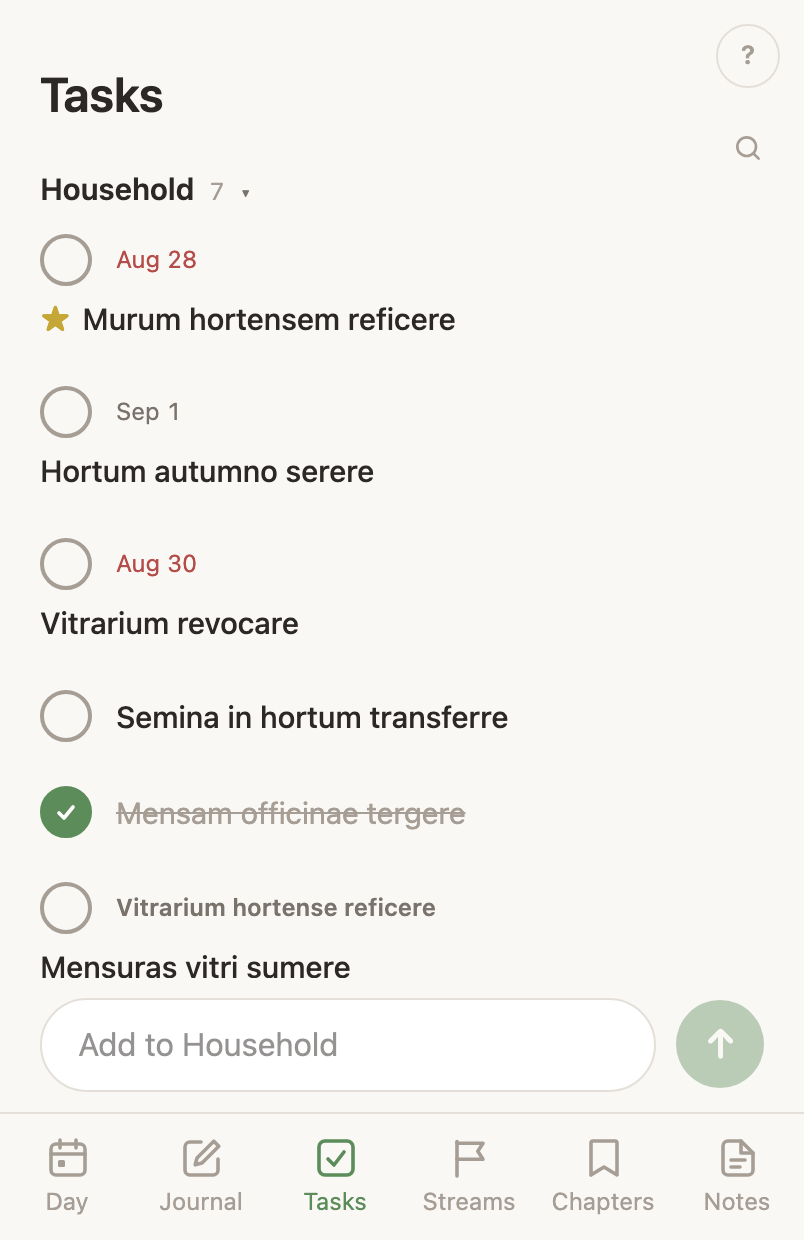
Tap the ring beside a task to complete it. The task strikes through and stays exactly where it was for a second and a half, then fades off the list — long enough to see that it worked, and to change your mind. Tapping the ring again during that pause keeps the task, on the status it held before, unless that status was itself a closed one, in which case it comes back Open.
Search your tasks
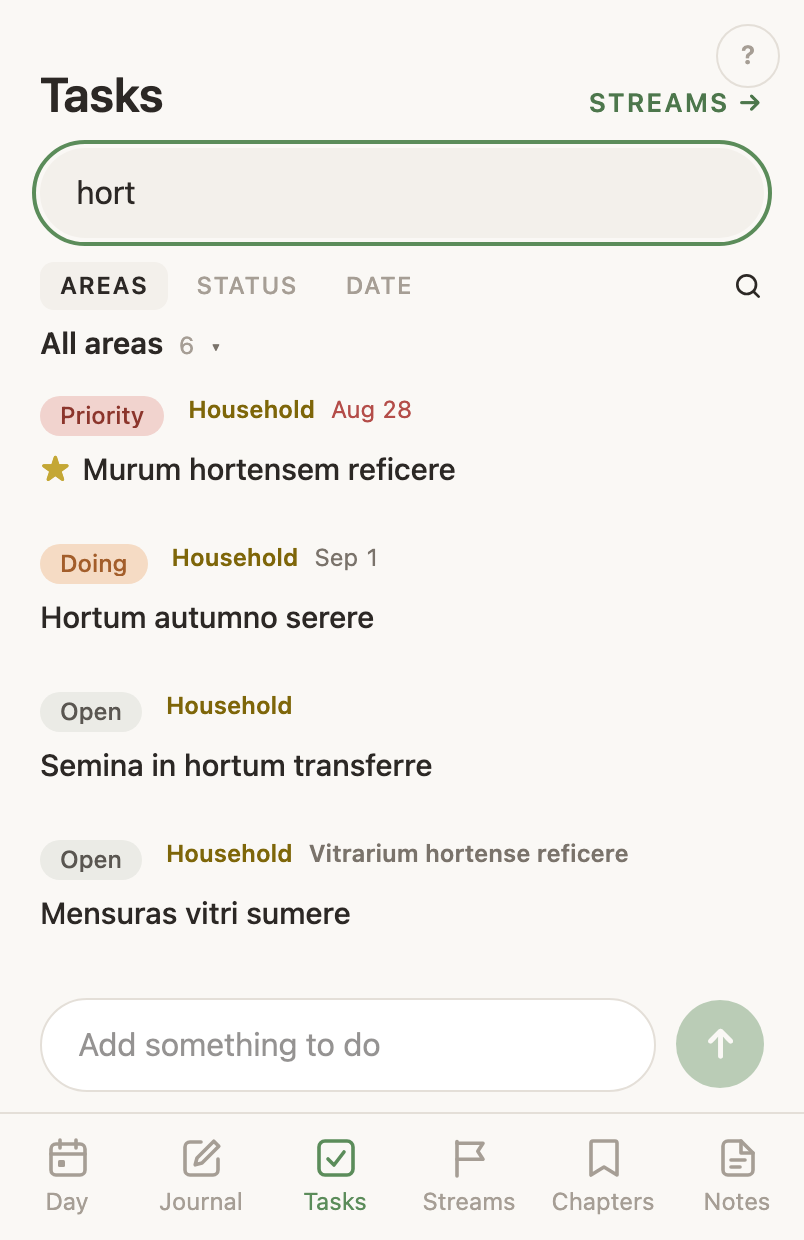
The magnifier above the list opens a field that covers every life area at once, and it matches a task’s words, its area and its stream. It searches what is open, so a task you already finished is not there.
A task’s sheet
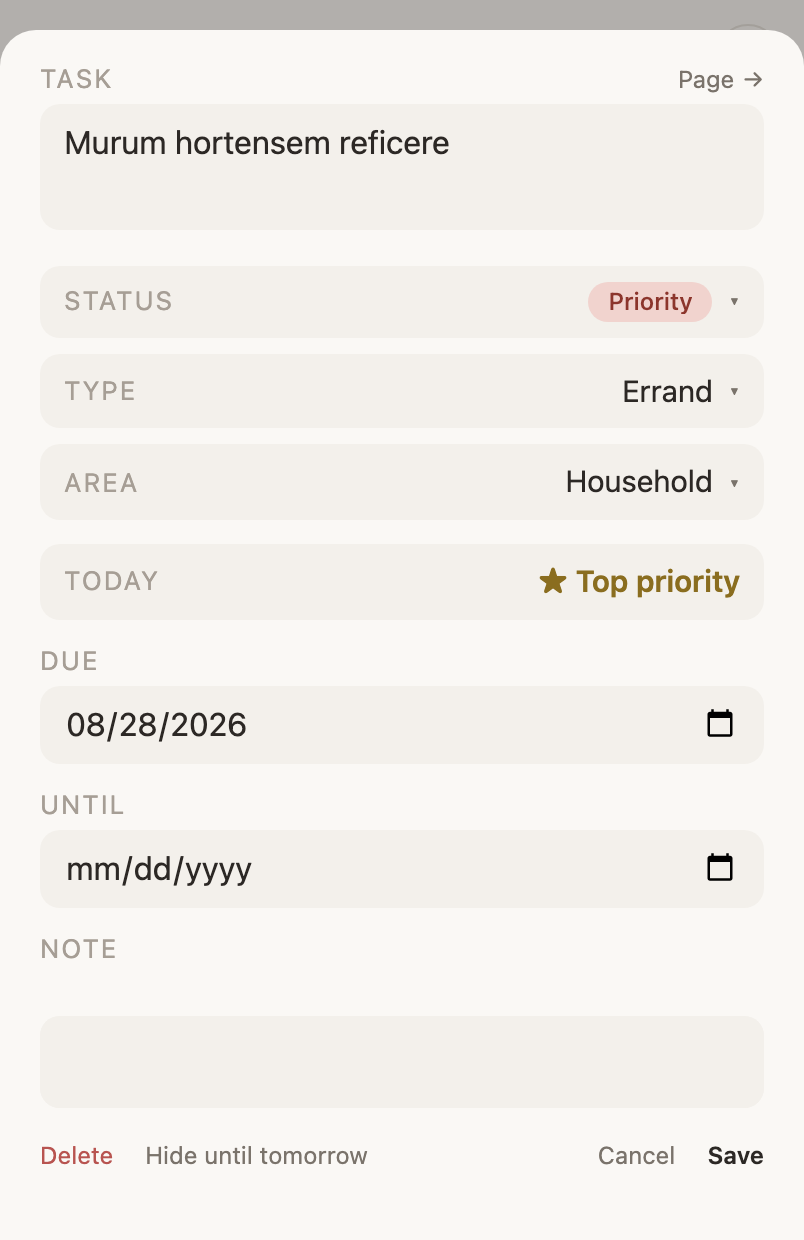
Tapping a task’s row opens its sheet, where you change the words, the due date and the note. With Streams & task detail on, the sheet also has a status, a type, a life area, and an Until date for work that runs across days. Delete and Hide until tomorrow are along the bottom, and Page in the top corner opens the task’s own page.
A task’s own page
A task opens into the same page a stream does. The top gives its name, its status, its life area and its today star. Under that comes the long-form writing in the editor documents use, with History in the top corner. Then its subtasks and the journal written against it, one after the other, each with a bar at its foot for adding. A task has no movement verdict and no Notes fold. Those belong to a stream.
Open a task’s page
On the web a task’s name is the link: click the words on any row, or Page in the corner of its sheet. On the phone a row keeps its one tap target for the sheet, so the way in is the sheet’s Page row, and a task name printed on a page itself.
Add a subtask to a task
Add a subtask at the foot of the list makes a task under this one. A subtask is an ordinary task with an ordinary row, and its name opens the same page one scale down. There is no limit on the depth.
Write a journal note against a task
Add a note at the foot of a task’s page writes a journal entry filed to that task, so it reaches your Day and your Journal like anything else you write. The entry takes the task’s life area and its stream as it is created.
A task’s note
The note on a task’s sheet takes the same writing a document does. Typing - starts a real list item, and a photograph dropped or pasted in lands where you put it. The box looks like a plain box and stays one, with no toolbar and no menus, and it saves itself as you write. A long note scrolls inside its own box instead of pushing the rest of the sheet down.
Move a task to another life area
Pick a different area on a task’s sheet and the task leaves one list and joins the other.
A refused change keeps your words
When a change cannot be saved, the sheet stays open holding every word you typed and says what went wrong. The list does not move until the server agrees, so nothing ever reads as saved when it was not.
Delete a task
Right-click a task on a laptop, or open its sheet on a phone. Delete asks first, then removes the task for good.
Star a task as Top priority today
Top priority today stars a task and floats it to the top of whatever list it appears in, with the star showing on its row. The star runs out overnight.
Hide a task until tomorrow
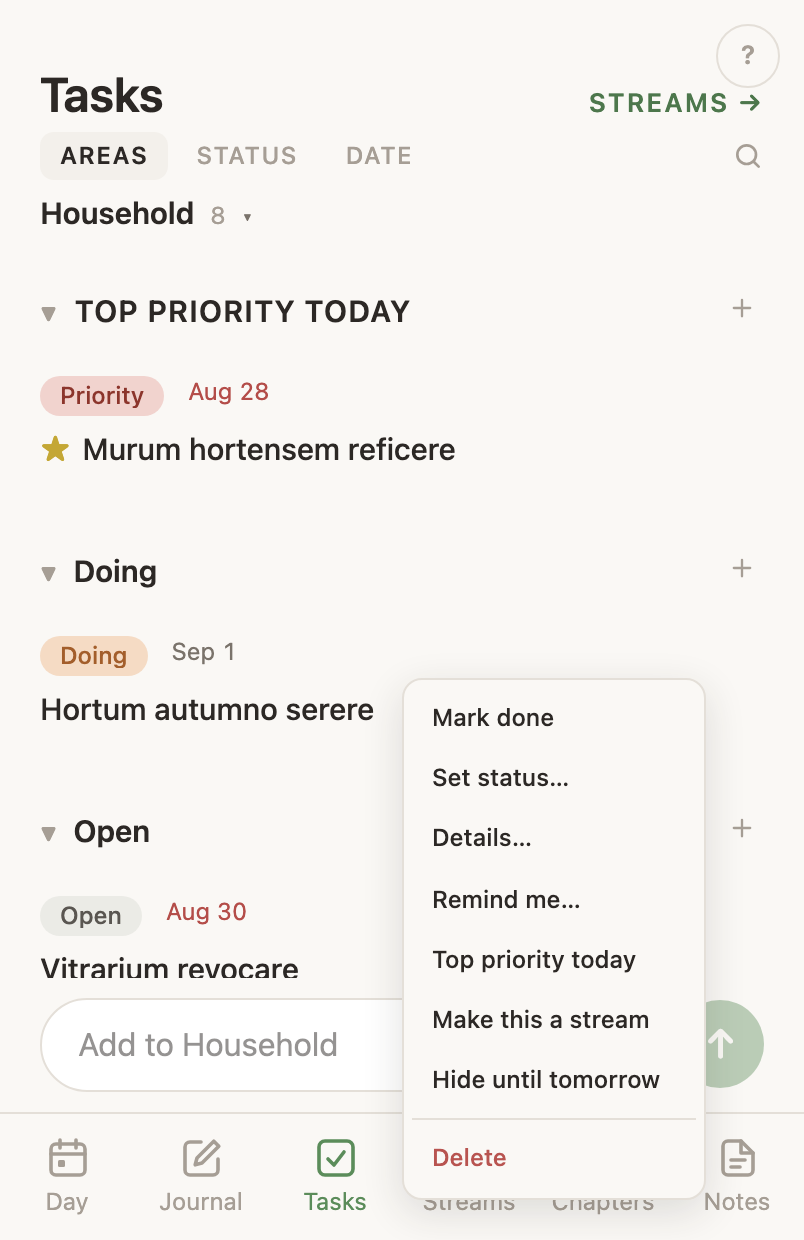
Hide until tomorrow takes a task off today’s list until morning. Its due date does not move, and the task comes back on its own.
A late date turns red
A due date that has gone by reads red on the task’s row, wherever that row appears.
Statuses
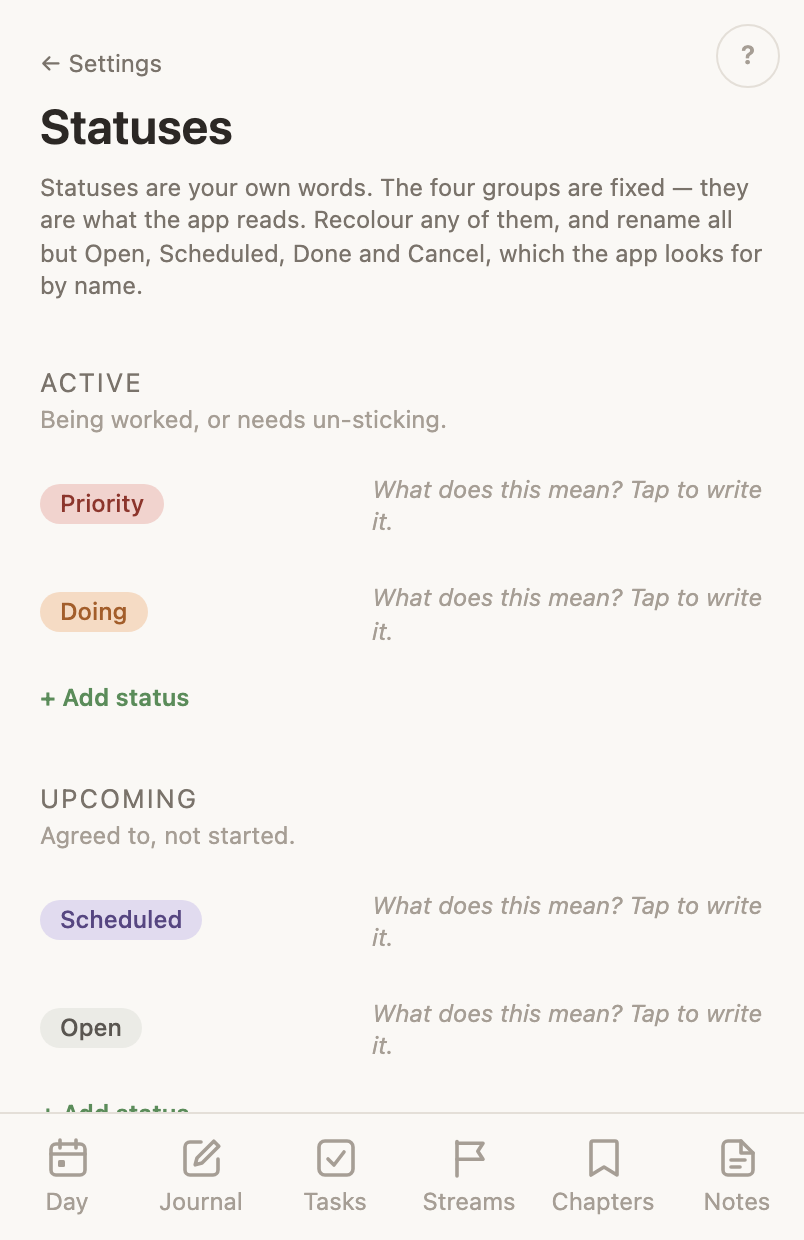
A status says where a task stands, and the words are yours. Recolour any of them, add your own, write what each one means, and rename all but Open, Done and Cancel. Every status belongs to one of four fixed groups, Active through Closed. Deleting a status moves its tasks to a status you pick.
Status headings inside a life area
A life area holding more than one status splits under those status words, each with a count. An area where everything is Open stays a plain list.
A task dated ahead moves to Scheduled
Scheduled is one of your statuses, sitting just ahead of Open. Give an Open task a date still to come and it moves there: the row says Scheduled, the picker shows Scheduled, and it heads its own section wherever the list is split by status. The morning its date arrives the task goes back to Open on its own. A task carrying any other status keeps that status whatever its date, so work you marked as mattering now stays where you put it. Move a task out of Scheduled yourself and it stays where you put it too — nothing moves it back. Because it is an ordinary status, its heading takes a new task and takes a dragged one, the same as Open or Priority.
Change a task’s status from its row
On the web a task’s row shows its status word, wherever the list is not already split by status. Tap that word, pick another, and the task is saved without the sheet opening.
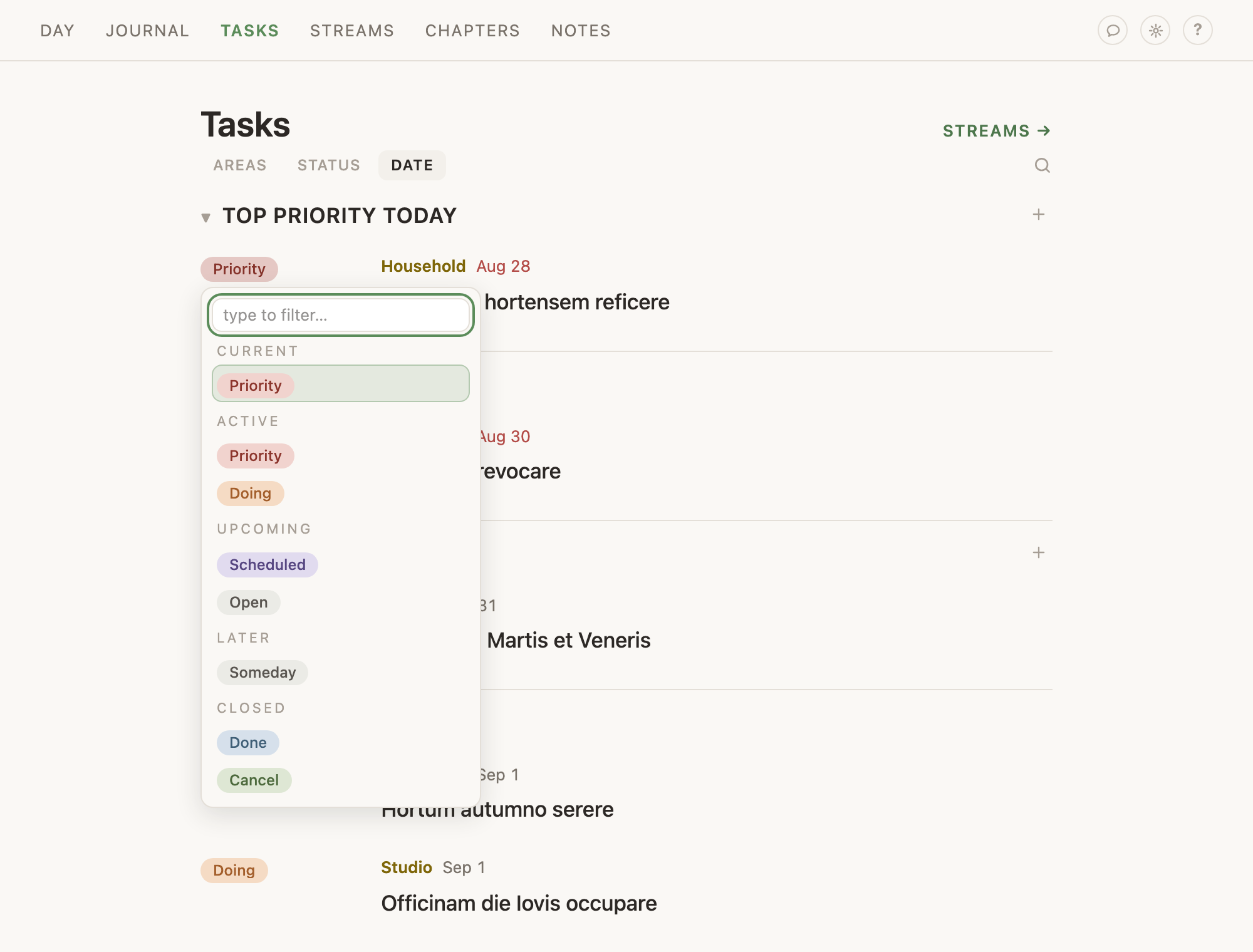
Task types
A type is your own word for the kind of work a task is. It shows on the task’s sheet and is picked there. A row with no type says No type rather than claiming one.
Name a new task type
The type field on a task’s sheet narrows to the types you already use as you type, and the same box names a new one.
The views
Areas, Status and Date appear in a row above the list, and each one arranges the same open tasks a different way. Tasks opens on Status. Date puts the overdue first, then Today, Next 3 Days, Future and No date, with any task starred for today lifted above them. Under Status every heading has a plus that adds a task with that status. Under Date only Today and Top priority today have one, since those name a day a new task can be given. Overdue, Next 3 Days and Future name a range and take none. The bar at the foot adds to the area you are in under Areas and to no area under Status, and Show finished belongs to Areas alone.
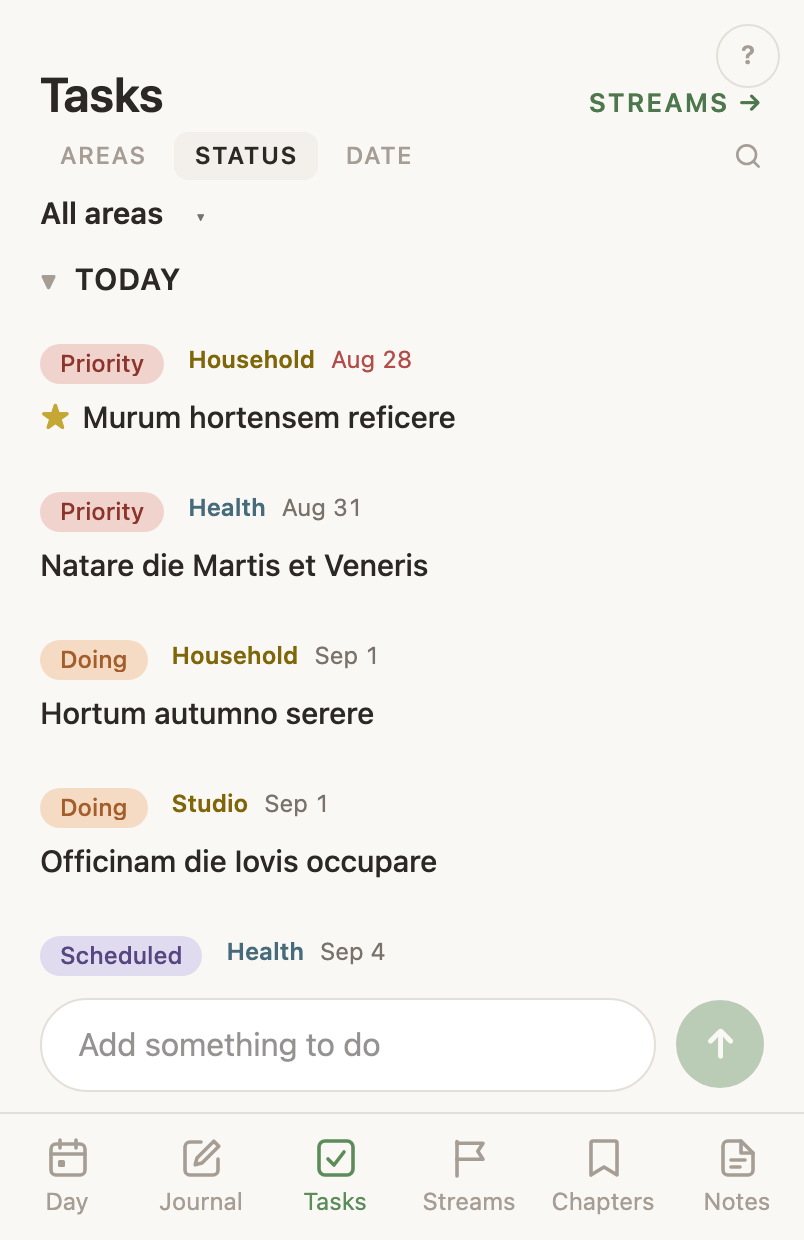
Swipe between the views
Drag the list sideways to reach the next view, or use a two-finger swipe on a laptop’s trackpad. It stops at the ends rather than wrapping around.
Drag a task onto a status
In the Status view on a laptop, drag a task onto a status heading and the task takes that status.
See the tasks you finished
Show finished at the bottom of the list brings back the fifty you finished most recently, across every life area, each with the status it closed on. The ring beside a finished task reopens it.
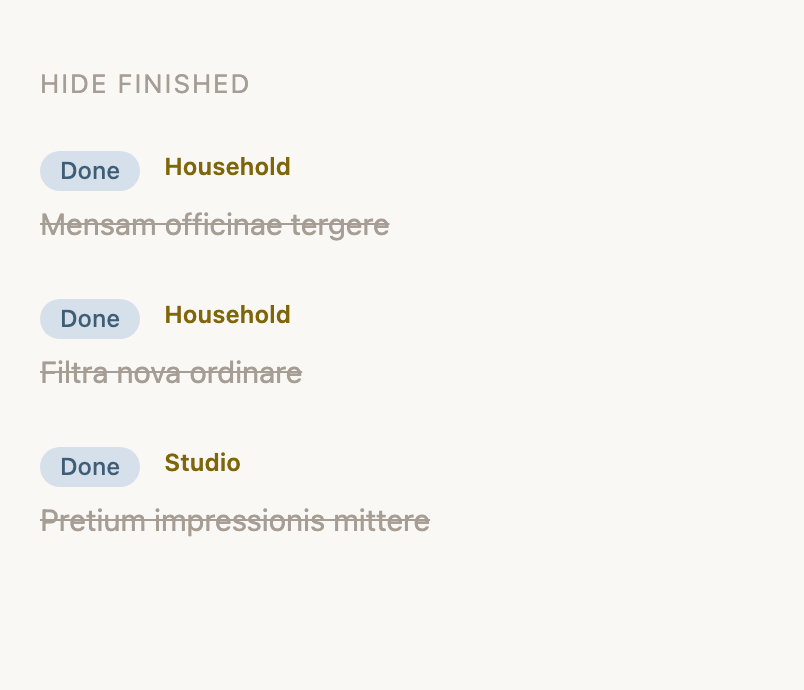
Open a task from the Day
A change on the Day opens the task it changed, straight onto that task’s sheet. A task you have already finished says so and offers to show the finished list.
Find a stream’s tasks
From a stream’s sheet, one link opens Tasks with that stream’s name already in the search field. The list you arrive at is the tasks underneath that stream.
NotesLonger writing has its own tab, Notes
The document list
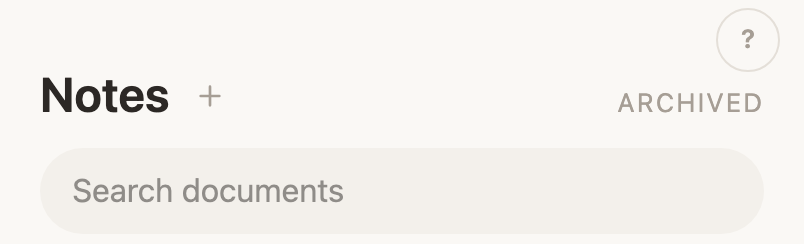
Notes lists every document you have. Grouped by life area it sections them under their areas. Ungrouped it runs newest first by the date each row shows, so a new document starts at the top and renaming one does not move it. The search field is the way back to the one you were writing in last week.
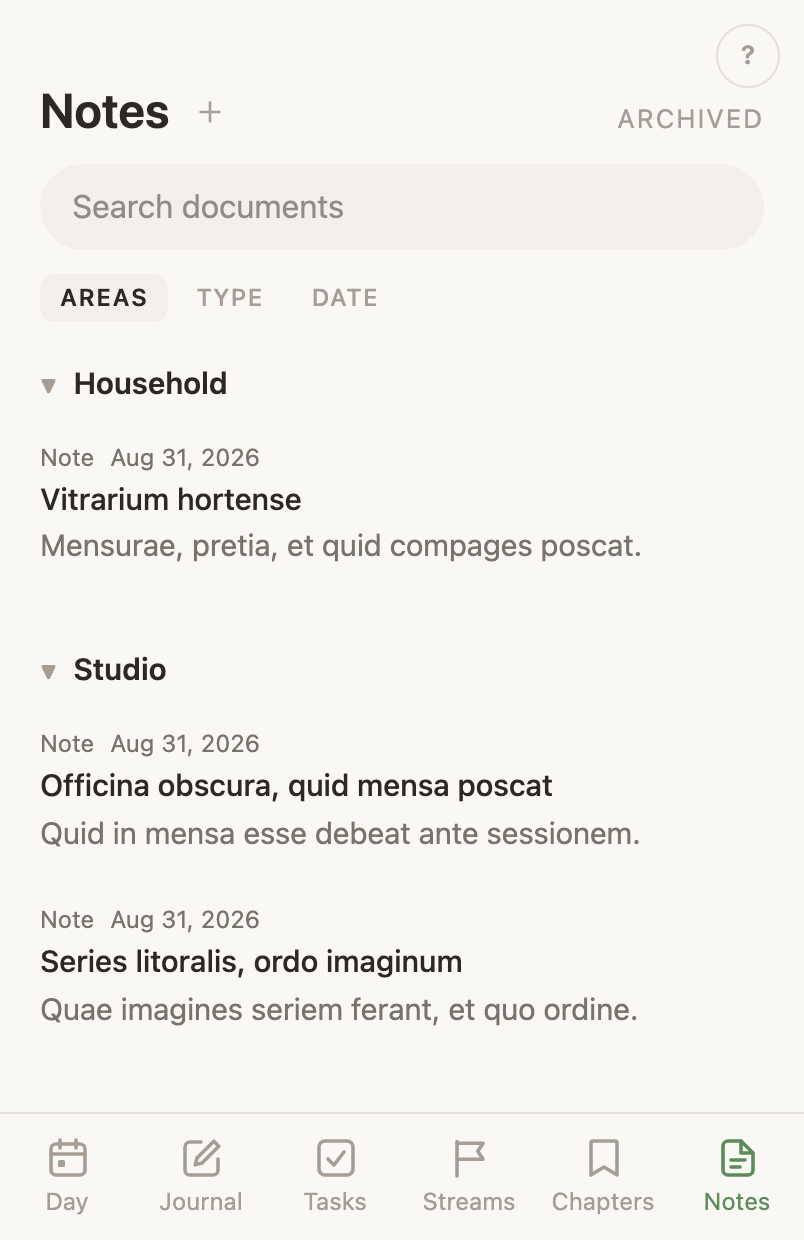
What a row says
A row gives its labels above the title — the type, the date, and the initiative or life area when it has one — and its description under the title. A date the app cannot read shows as nothing at all rather than as an error.
Start a document
The plus on the Notes tab makes a document and opens it, unnamed with its title field waiting, and a long journal entry you give a title becomes one as well. Both routes make the same document, and the one from the Journal keeps its place in that day. A long entry with no title stays an entry.
File a document under a life area
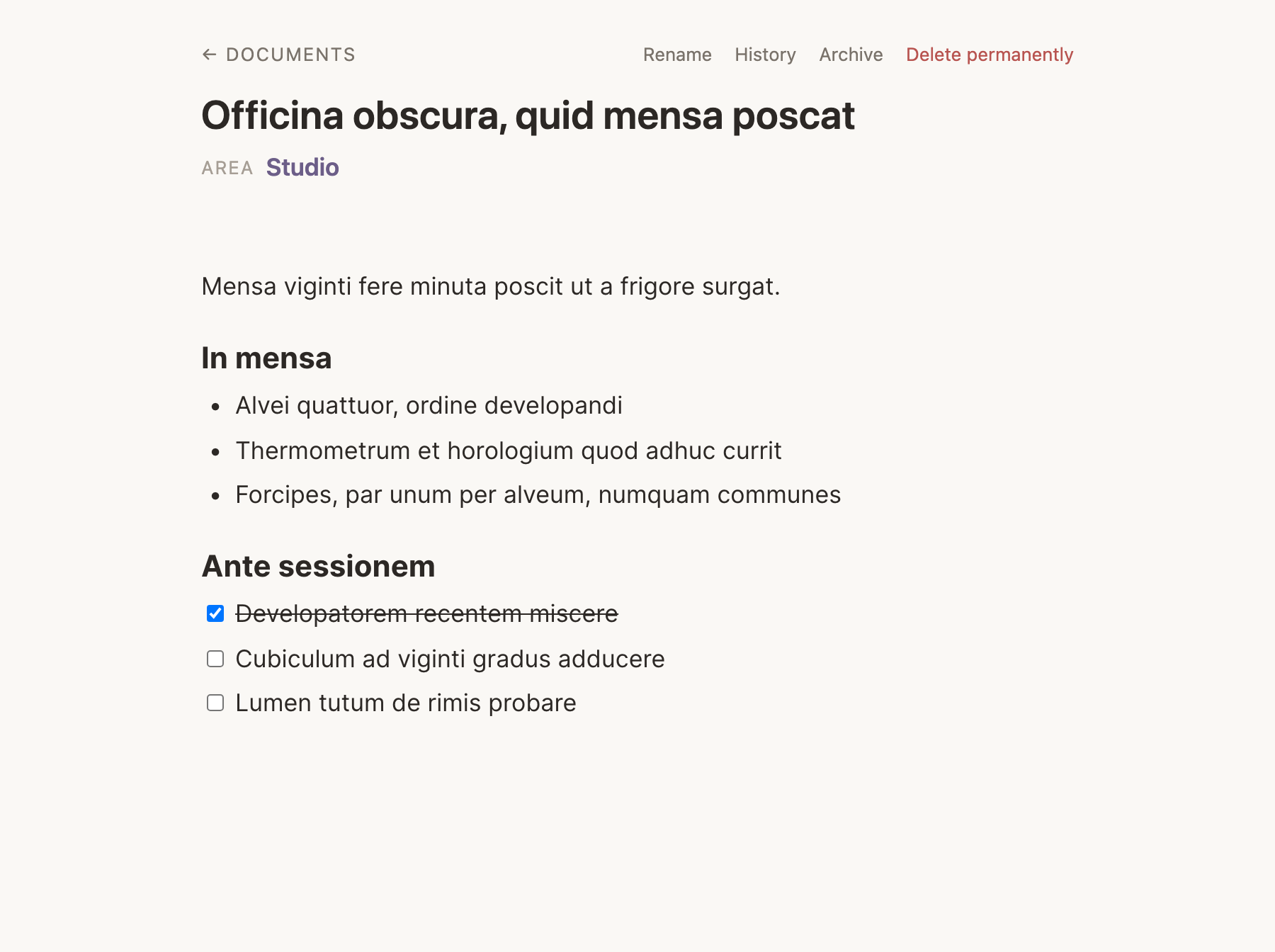
On the web, an open document shows the life area it belongs to under its title, in that area’s colour, and No area when it belongs to none. Clicking it lists your areas, filtered as you type, and picking one files the document there. Picking No area at the bottom takes it back off, and the sweep leaves it off. The phone has no control for this yet.
A document with no life area is filed for you
With AI on, a background sweep reads a document that has no life area and files it under one of yours. It reads the name, the kind, the description and the text. A document it cannot place stays unfiled, and it is asked about again the next time you add, rename or remove a life area — the list it was choosing from has changed. One you file yourself it never touches. Your pick always replaces its own.
Rename a document
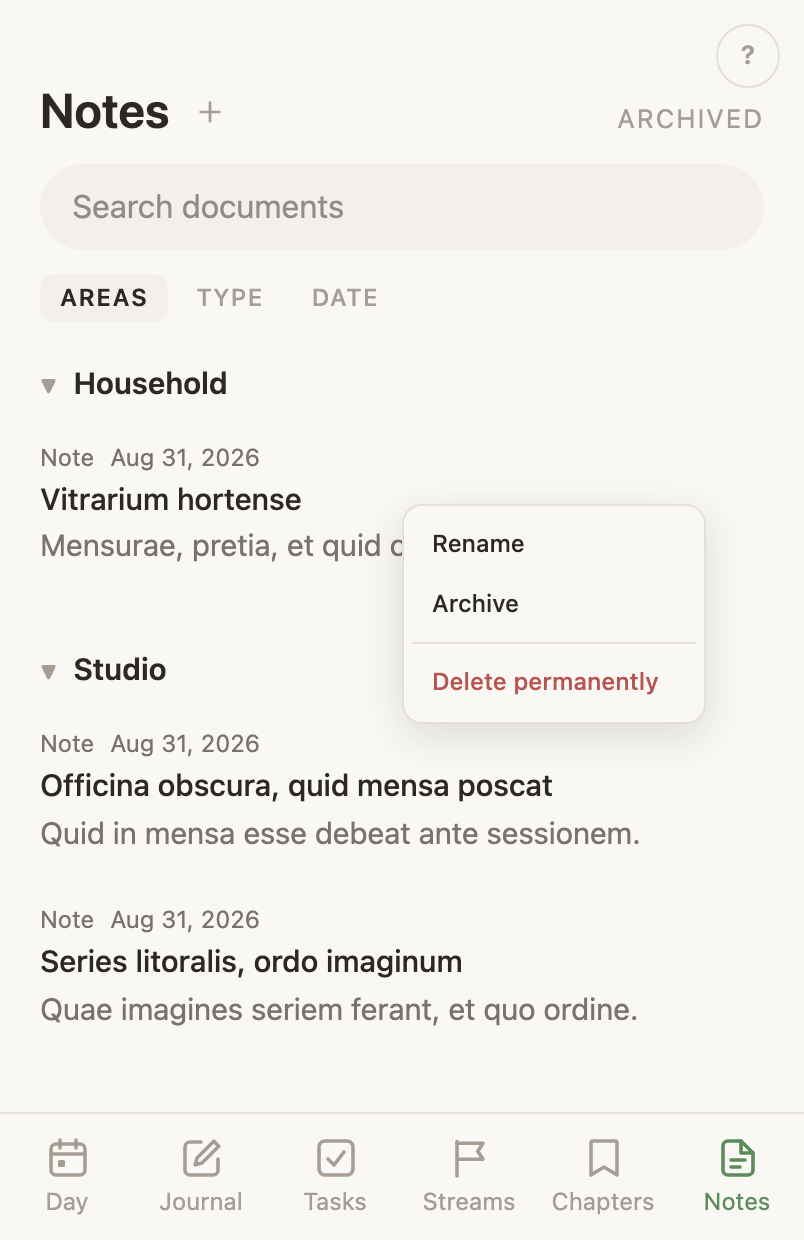
On the web, click a document’s title to rename it, or right-click its row in the list. On the phone, Rename is under the ⋯ at the top of the open document.
Archive a document
Archive takes a document out of the list and keeps every word of it. Archiving leaves you on the list it just left, even when you opened the document from a journal card.
Restore an archived document
The Archived link above the list opens what you put away, and Restore puts one back. Restoring keeps you on the document.
Delete a document
Delete permanently asks first. The document and its text are then gone.
Document search
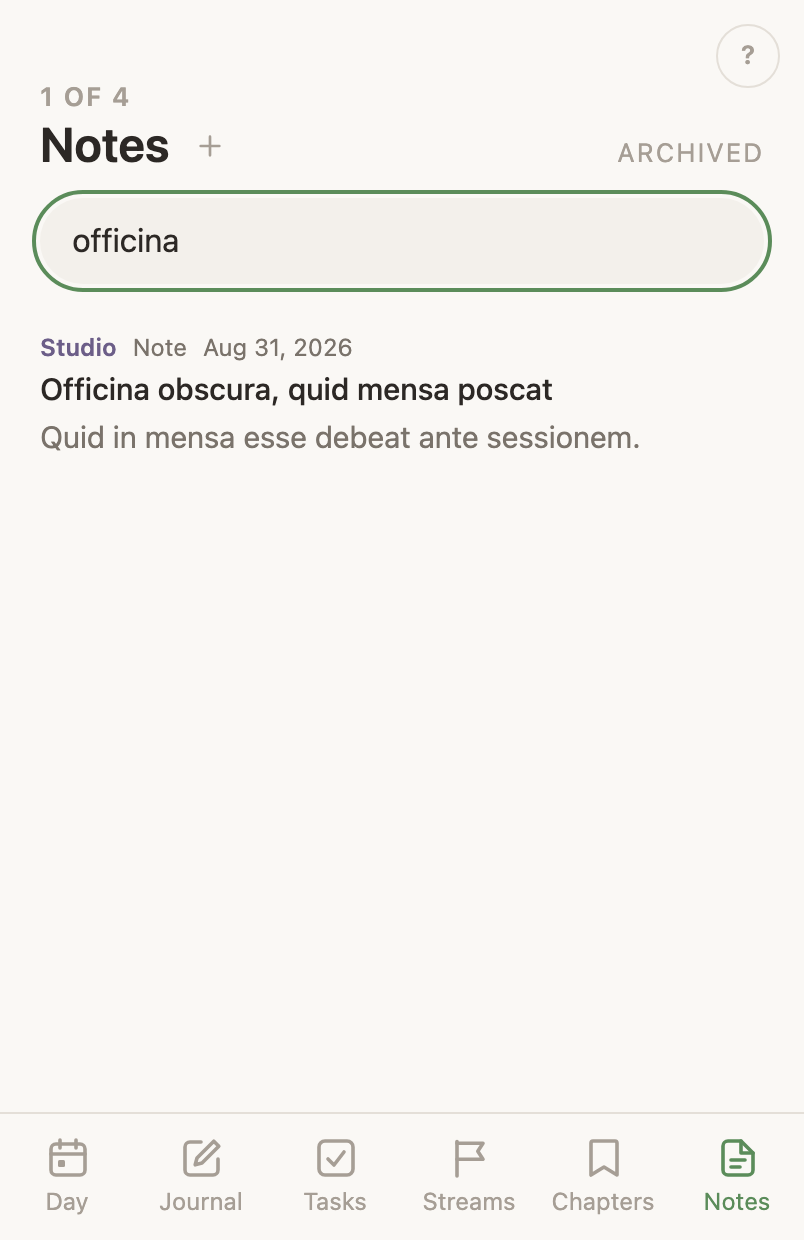
On the web the search field reads the text inside your documents, as well as the title, description and labels on a row. When the server cannot read inside them, a line under the field says so. The phone’s field matches only what a row shows, and the Journal’s magnifier reads inside a document there.
Search covers the live list only
Searching covers your live documents and leaves the archived ones out, on purpose. The way back to what you put away is the Archived link above the list.
An open document
An open document shows its title, its text, and a way back that names where you came from. Journal from a journal card, which returns you to that day. Documents from the list, Archived from the archived one. The title always comes from the document, so a link saved before a rename opens under the current name.
Edit a document on the web
On the web every document is fully editable, formatting included: headings, bulleted and numbered lists, and checkboxes. It saves itself moments after you pause.
Leaving the page mid-save
The browser asks before you leave with words that have not saved yet, and a save still in flight goes out as you go. If it dies on the way, the document says so the next time you open it, so a lost save never reads as stored.
A document that will not load stays shut
When the text cannot be fetched, no editor appears. An empty editor saving itself over writing the app could not read is how a document gets quietly emptied, so the editor stays shut instead.
The history panel
History at the top of an open document opens a panel beside the text, listing the versions the document has passed through, newest first. Each one gives its time and a plain sentence saying what moved between it and the one before. Show earlier saves opens the quieter list underneath, one row per sitting rather than one per save, since a run of writing with no half-hour break in it is one sitting. A stream’s page and a task’s page have the same panel over their own writing.
Read a document as it was
Clicking a version swaps the document on screen for what it said then, drawn by the editor rather than printed as source. The panel stays beside it, so you can move between versions and come back to the current text.
Restore a document to an earlier version
Restore this version, above the version you are reading, makes it the document again. The line under the button says what happens to the words you are replacing: what the document says now is kept as a version first, so restoring is reversible. The browser and the phone app both do this.
Name a version of a document
Save version keeps the text as it stands under a name you type, so a state worth going back to has a word on it rather than a time.
Read a document on the phone
The phone shows a document with its headings, lists and checkboxes, and you type into it where it stands.
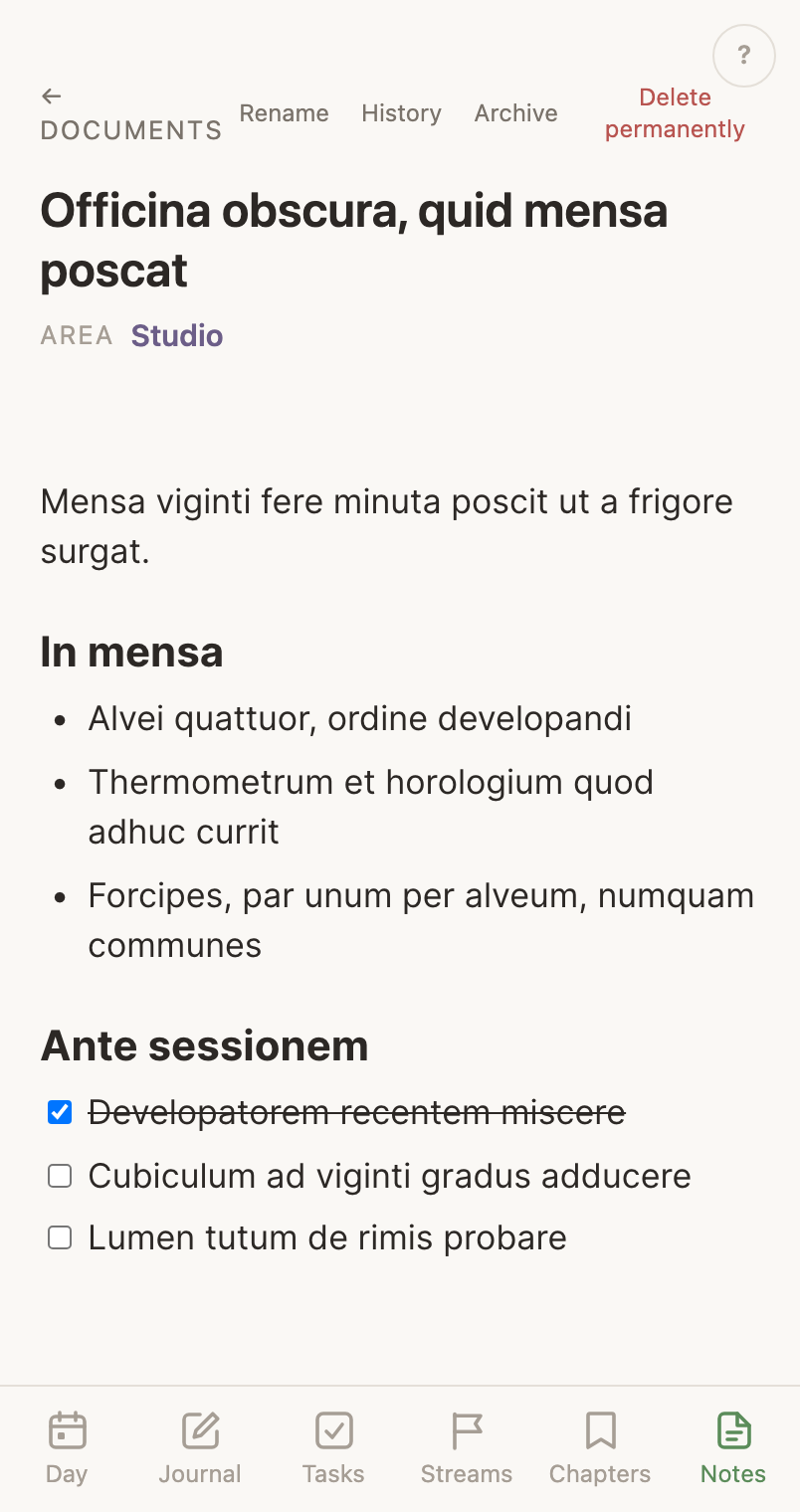
Edit a document line by line on the phone
In a document with headings or lists you tap a line to change its words. Clearing the field removes that line, and Return gives you another line of the same kind under it.
Add a paragraph to the end
A document full of headings and lists still takes one more sentence on the phone. Add a paragraph puts it at the end.
The lines the phone will not edit
A line carrying bold, a link or a colour says so when you tap it, rather than opening and dropping the styling on the way back out.
A document and its journal entry
A long journal entry you gave a title is an entry and a document at once. The entry on your timeline shows the opening of what you wrote, and tapping it opens the whole document.
Deleting a document keeps the entry
Delete a document and the journal entry keeps its words. It stops being a card that opens one.
An outage is not an empty shelf
When your documents cannot be fetched, the list says so and offers to try again. It never tells you that you have none.
DayDay draws your hours to scale
The timeline
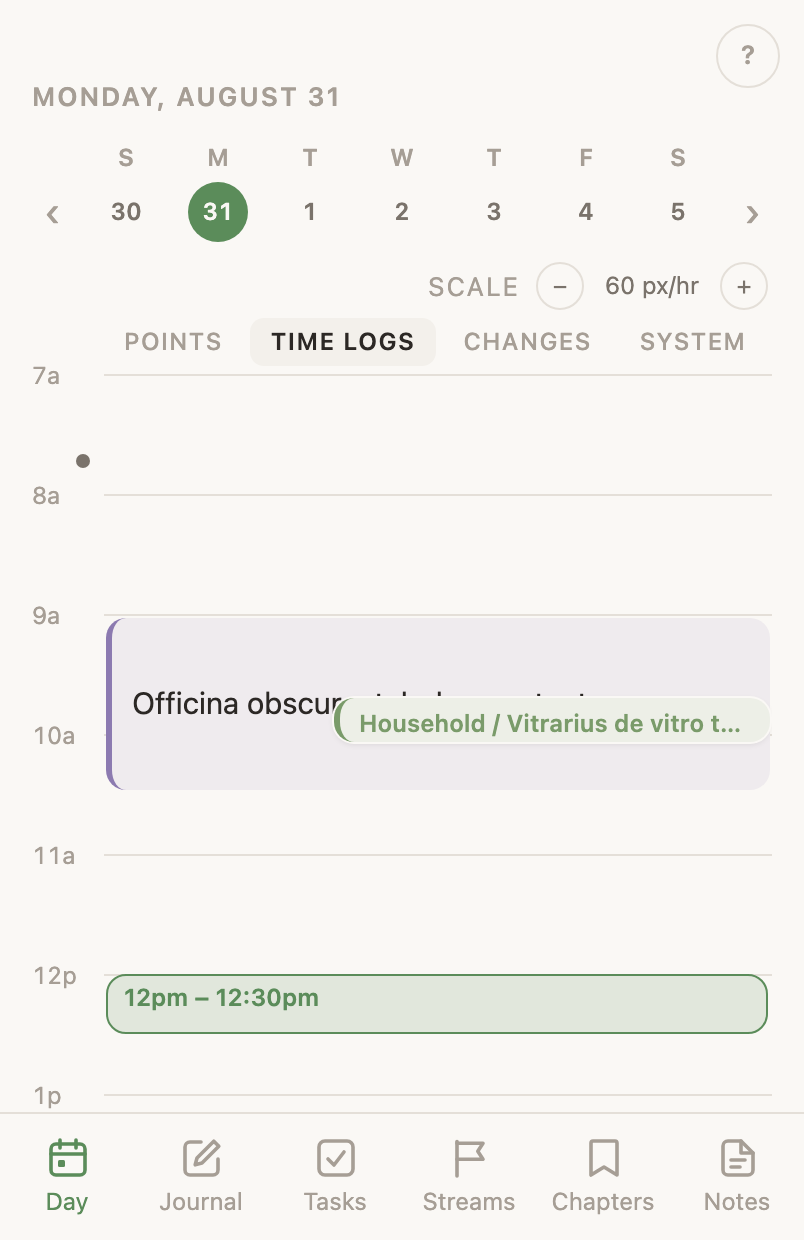
Your meetings show as blocks across the hours they took, and what you wrote shows on the same hours. A line marks now. You see a meeting and what you did during it in one place.
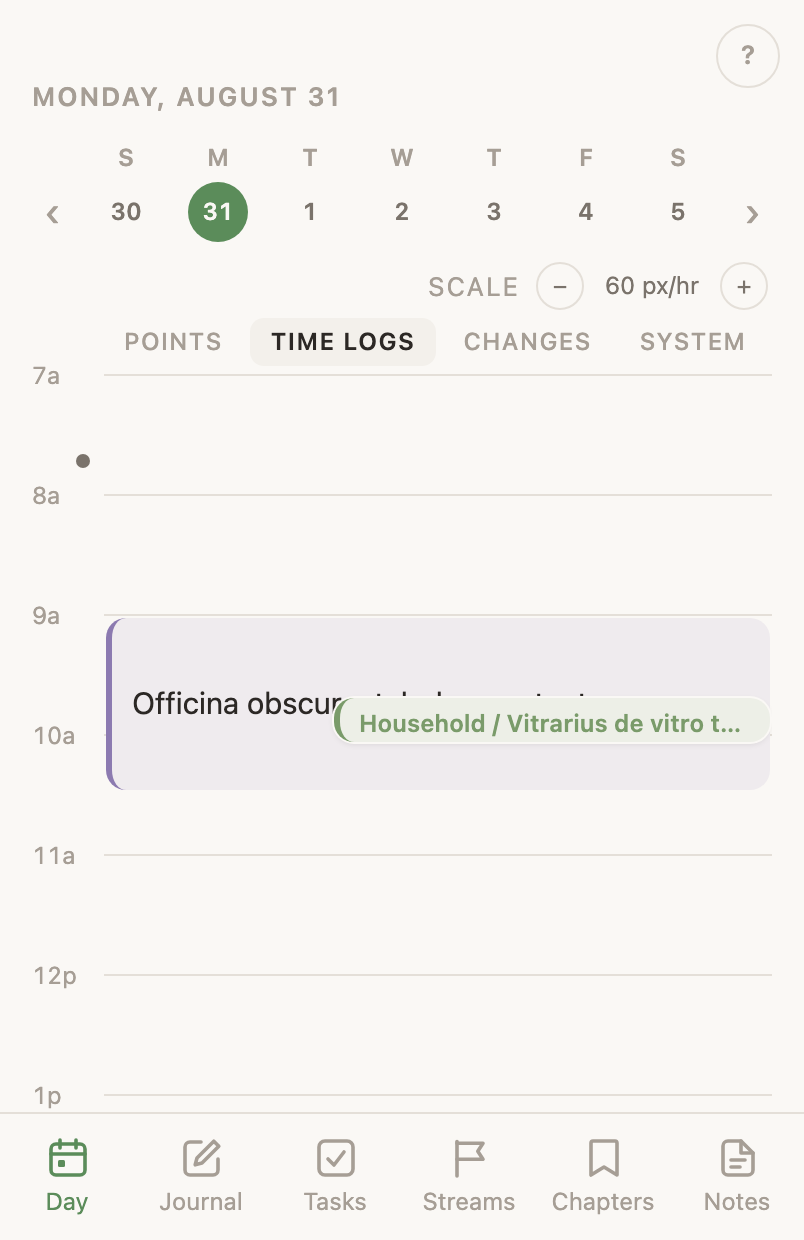
The columns
A wide screen shows four columns beside the hours. Points is what you wrote at a moment, Time logs is what you did for a stretch, Changes is what you made, deleted or edited on a task, a stream, a document or a chapter, and System is what your devices reported and what the app recorded on its own. A phone shows one at a time, and the tabs above them switch.
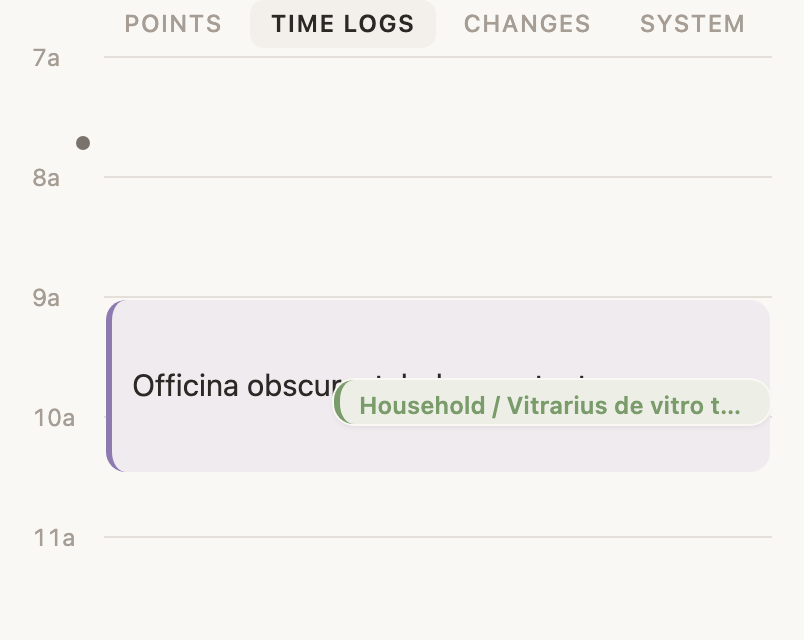
Draw a time log on the hours
Press on a blank part of the hours and drag down. The Day asks what you were doing and saves your answer across the stretch you drew. On a phone, hold still for a moment before you drag. Press without dragging and you get a single moment instead of a stretch.
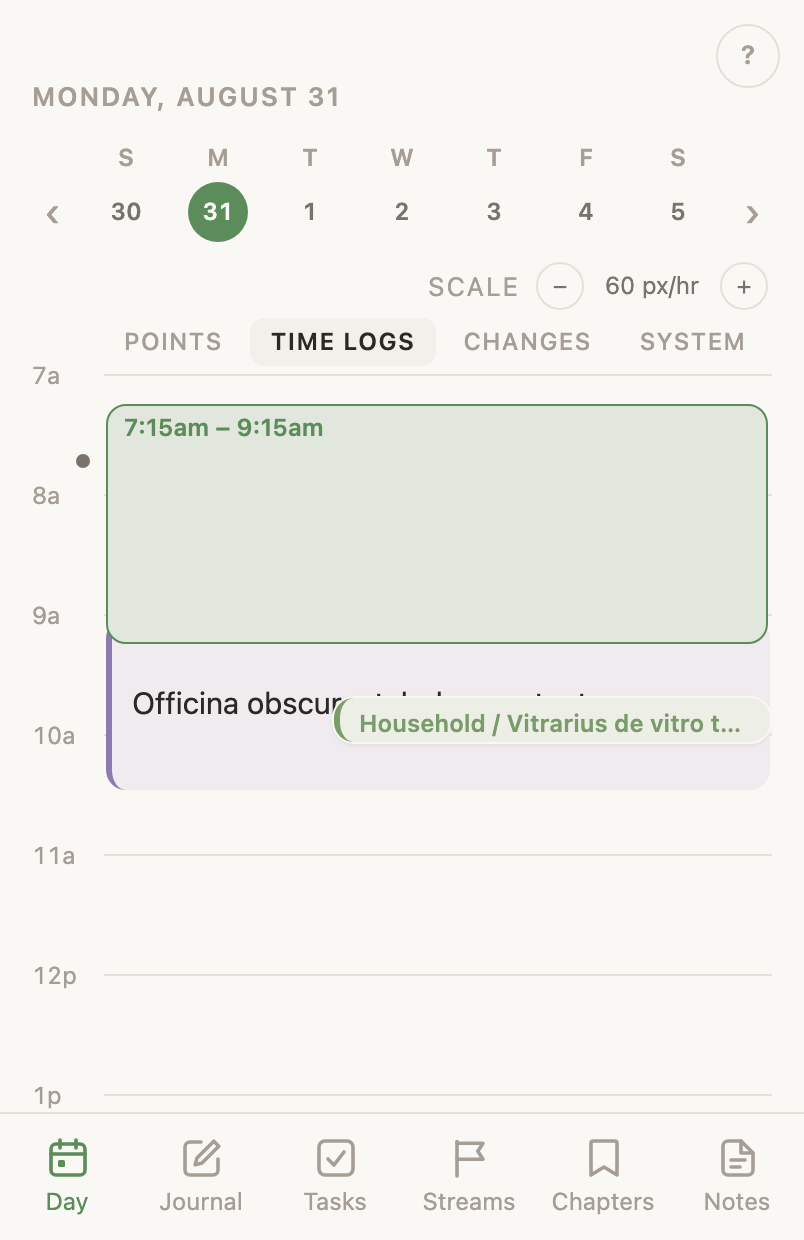
Tap anything on the timeline to open it
A time log, a moment, a meeting, a change: each one opens to its own words and its own time. One of your own entries opens with its time, its words to edit, and Delete. A meeting opens with Going, Done, which turns it into a time log, and Decline, which takes it off the day and answers no in Google without emailing anyone. Join the call appears when the meeting has a link.
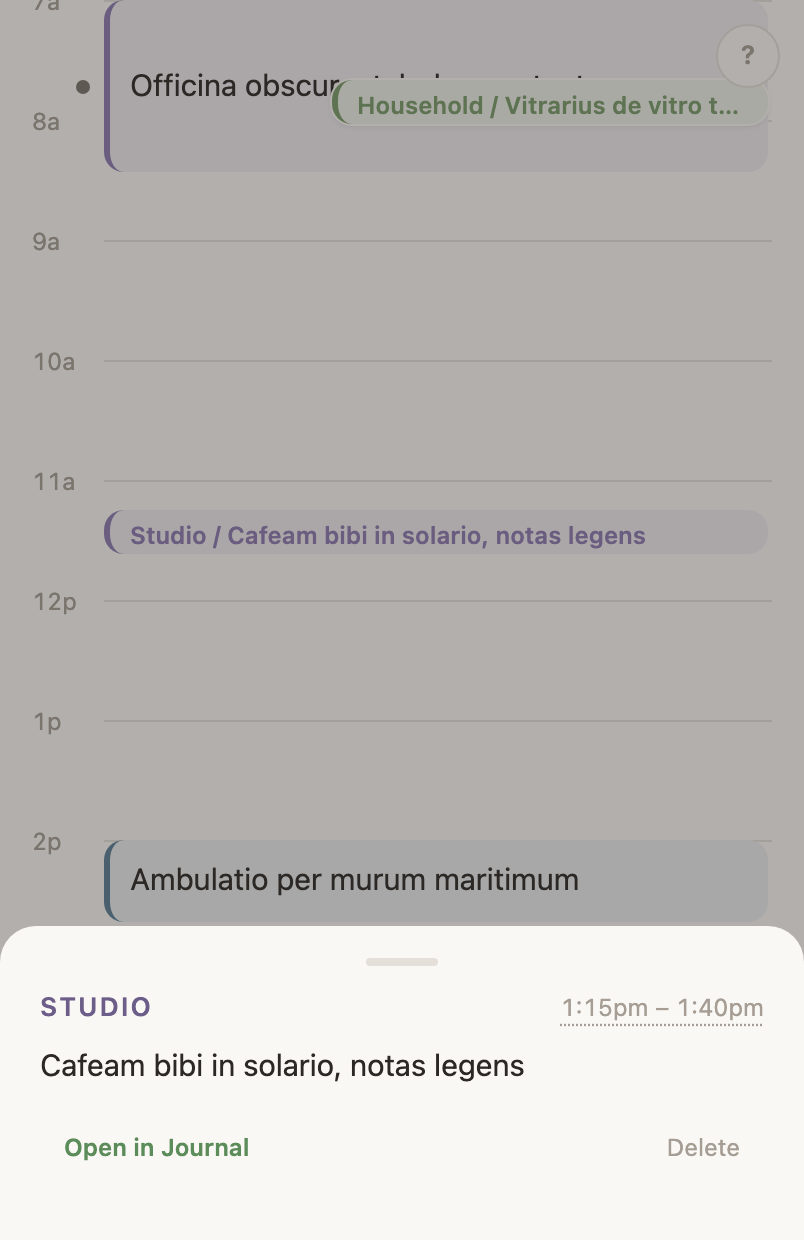
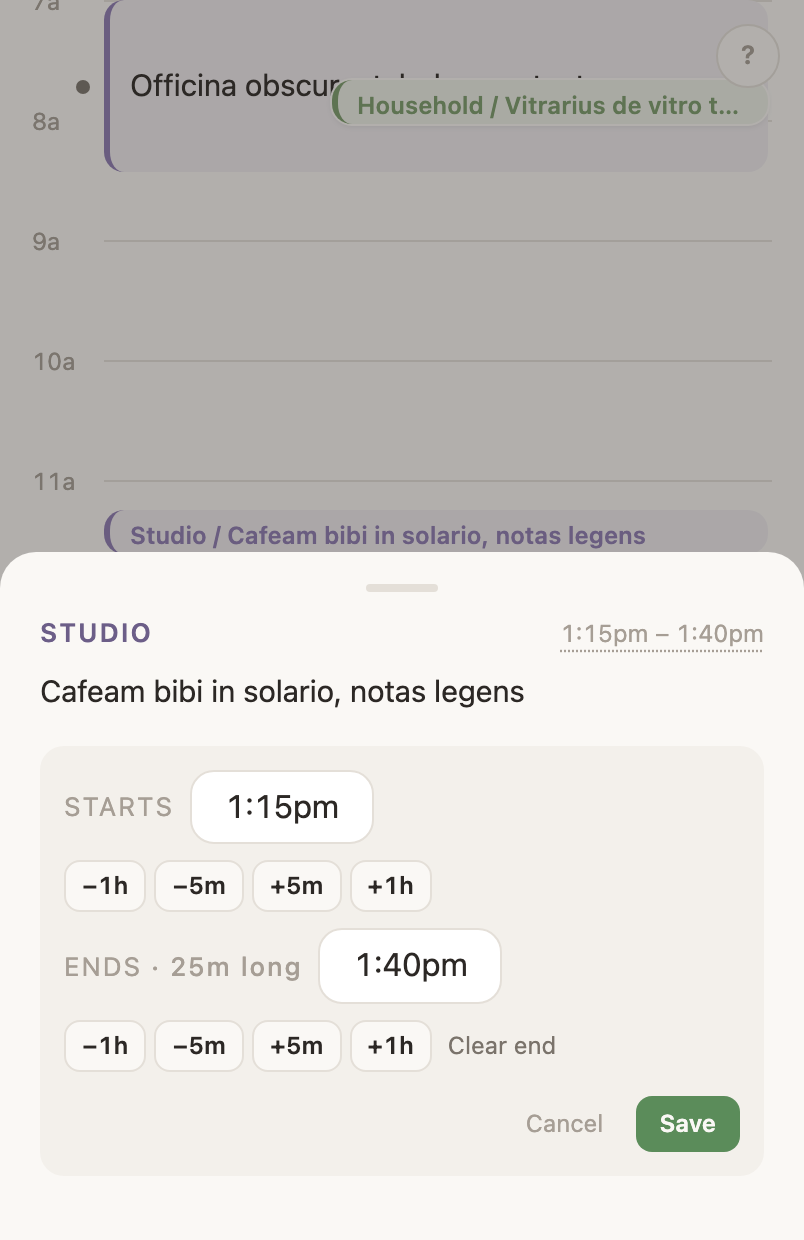
Change an entry’s time
Its time is the control: click the time on the web, or open Retime on the phone. Something logged at the wrong hour is fixed where you drew it, and moving the start moves the end by the same amount, so a stretch keeps its length.
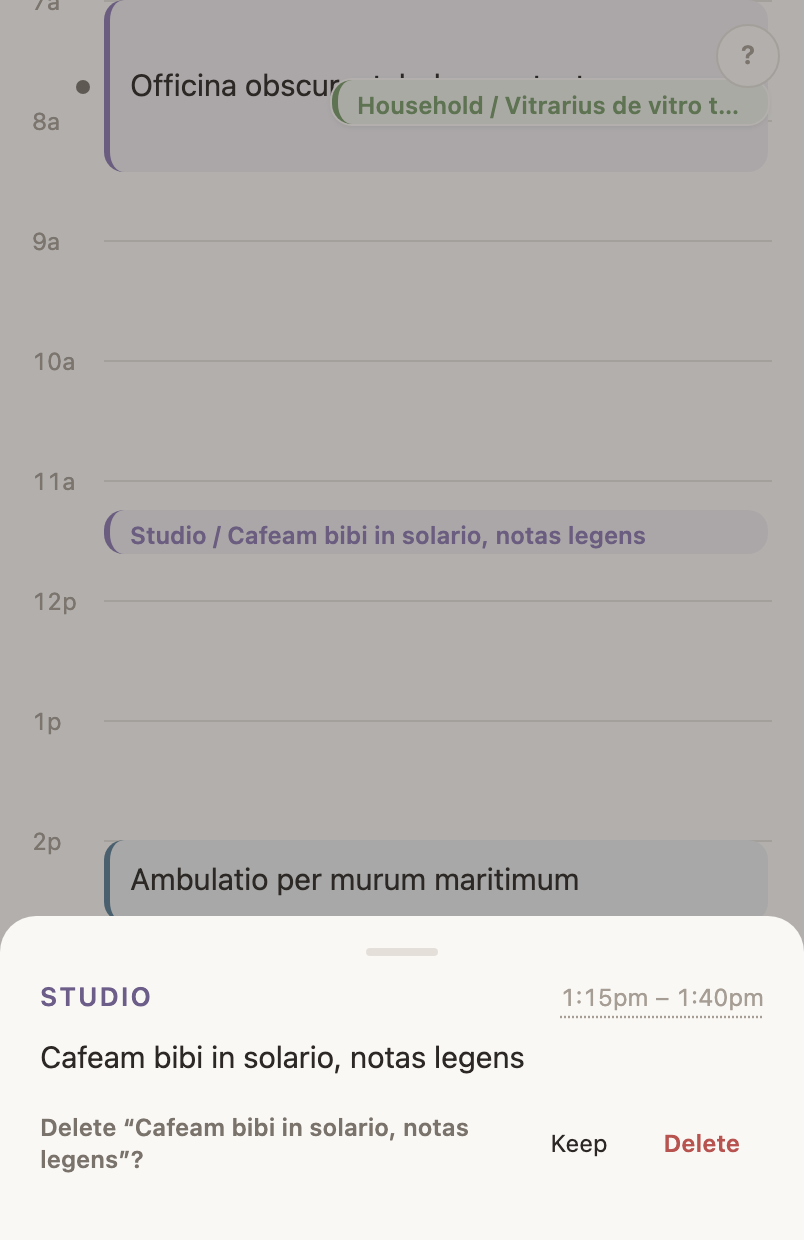
Delete an entry from the day
Delete asks once, by name. What you deleted then leaves every column at once and an Undo stands for six seconds, and nothing is sent until it runs out.
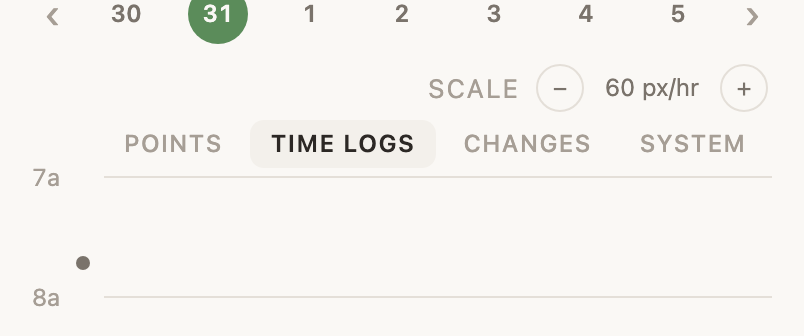
Scale the hours
Scale at the top of the day stretches the hours until a packed morning opens up, or shrinks them until the whole day fits one screen. The web remembers where you left it.
Untimed entries
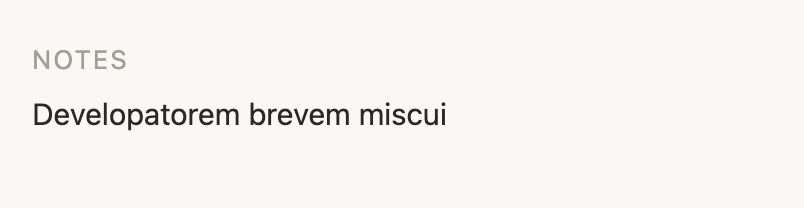
Entries with no time of day appear under the hours at the end of the day, under a heading the app calls Notes. An entry has no time when you wrote it while looking at another date, and each says how far from its own day it was written.
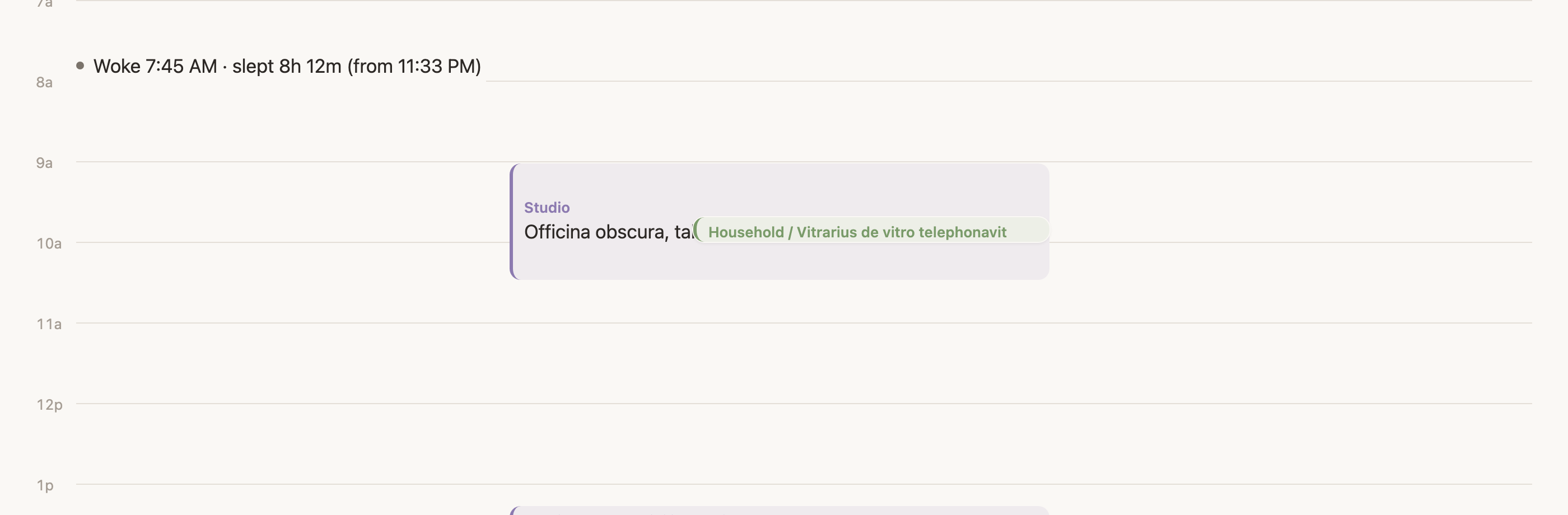
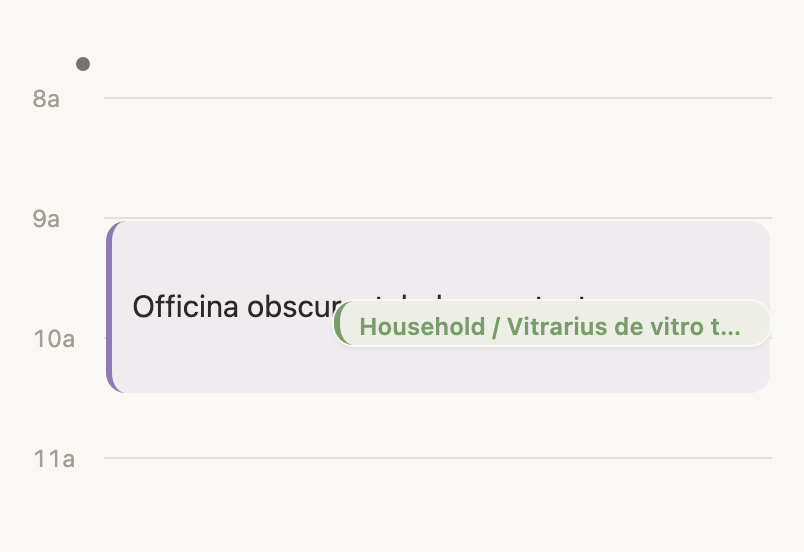
Blocks that overlap
Two things at once draw side by side. A brief interruption draws inset on top of the long block it interrupts, so an eight-hour block is not halved by a fifteen-minute one.
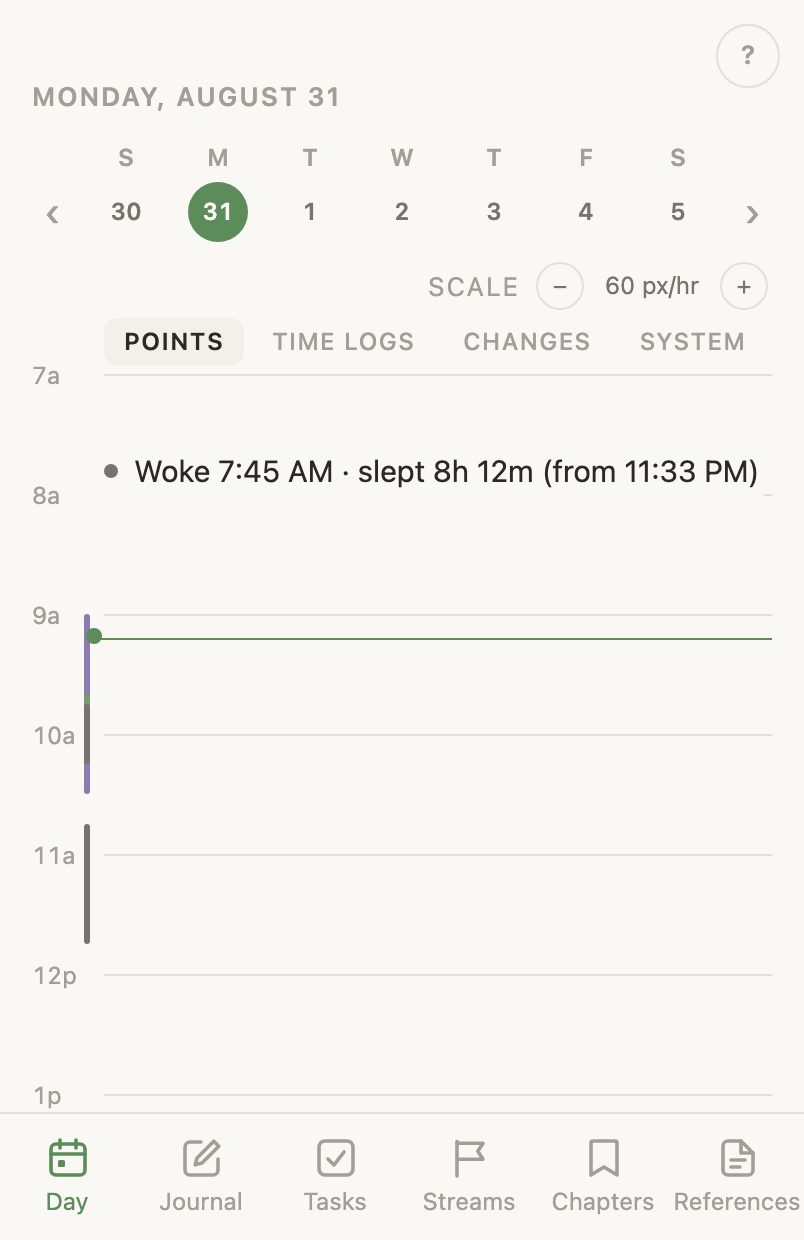
The gutter dots
On a phone, reading one column you still see the others. Reading Time logs, each moment shows as a dot beside the hours; reading Points, each time log shows as a short line at its own extent. Both take the colour of the entry’s life area, grey when it has none, and both open what they stand for. A wide screen has all four columns already, so it draws neither.
The timeline has two record layers, and a finish is one of them
The Day has two record layers and no third. A block occupies time, and a Changes row says what moved. A finished meeting is its work-log block, with the hours it took. A finished task is its Changes row, at the minute it closed. A tick, a badge or a dot saying a thing is done belongs to neither layer, so there is none. A fact that seems to need one means its record is missing rather than its marker.
Where a new time log starts on the hours
A log you draw starts on a quarter hour, or on the end of the entry just before it when that is nearer, so the day is not left with two-minute holes in it.
StreamsA stream is the long-running effort a run of tasks adds up to
Streams is on the menu either way; the Streams & task detail switch is what fills the page in. The browser and the phone app both have the screen.
A stream
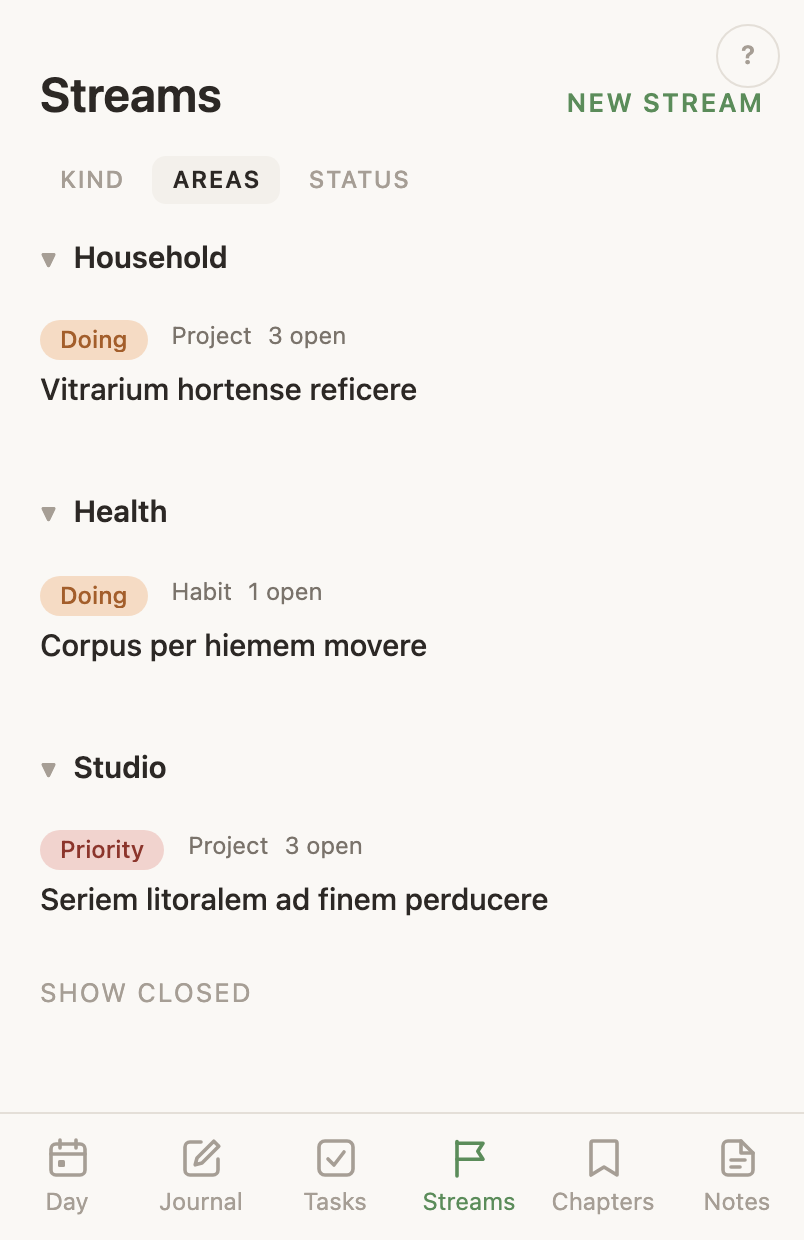
A stream is a name, a status you chose, your own word for its kind, and a life area. Its row reads the status in that status’s colour, then the area, then the kind, then how much is open under it. A stream with nothing open says nothing in that last slot, and the kind drops off the row while the list is sectioned by kind.
Section the streams by kind, area or status
Kind, Areas and Status above the list arrange the same streams three ways, the app’s own view bar in its usual place. Kind opens first, and the biggest section leads under any of the three. A kind you have no streams of gets no heading, and a list that is all one kind gets no headings at all. Streams with no kind gather under General at the end, and that slot reads No area or No status under the other two.
A stream’s own page
Clicking a stream’s name opens its page. The top gives its status, its area and a verdict on whether it is moving. Under that comes the long-form text in the editor documents use, with History in the top corner. Then its tasks and the journal written against it, one after the other down a single column, each with a bar at its foot for adding. Documents filed under the stream fold away under Notes at the bottom.
Make a stream
A new stream starts from its name alone, on the browser and on the phone alike. Renaming it on the browser happens on the menu on its row; on the phone you tap the name at the top of the stream’s own page. A task has no rename on its page at either tier — its words change on its sheet.
Make a task a stream
A task that turned out to be bigger than a task becomes a stream from its own row menu. It keeps everything it had, and any subtasks under it become the stream’s tasks. A meeting cannot become one.
One name, one stream
A task finds its stream by name, so two streams cannot share one. The refusal comes on creating and on renaming alike.
A stream is closed, never deleted
A stream that is over takes a closed status and moves behind Show closed. The app offers no way to delete one, so what you were once aiming at stays readable.
The movement verdict
A stream’s own page says Moving when something happened on it inside two weeks, and Stalled since the day it last did when nothing has. It reads the stream’s tasks and the writing against it. A stream nothing has happened to yet gets no verdict rather than an invented one.
ChaptersA chapter names a stretch of days you lived
A chapter
A run of days with a name on it: a season of travel, a stretch of work, a move. It has no progress and nothing to finish, which is what separates it from a stream, and it covers days rather than an hour, which is what separates it from a meeting. A chapter IS its span, so its row leads with its dates.
An approximate end stays approximate
An end date is read one of two ways, and the sheet offers both as words: On that day or Around then. A chapter taken past an Around then end is still running. Only On that day completes one. An approximate end shows with a tilde, so a date never claims a precision you did not give. The choice appears only once the chapter has an end date.
You set the stance, the calendar sets the state
You mark a chapter Committed, Maybe or Canceled. A committed chapter then reads as committed before its start, active once it has begun, and completed after a hard end has passed, worked out fresh each time it is read.
The days inside the span are its days
A chapter covers a run of days, so the entries written on those days are its entries. That is the whole relationship: filing something into a chapter is not a thing you can do, and moving its dates moves what it covers.
A chapter can sit inside another
One trip inside a longer travel stretch is a chapter within a chapter, and both are true at once.
Name a chapter to make one
Typing a name and adding it creates the chapter with no dates on it, which is an intention rather than a span. Its dates and the rest come from its sheet afterwards. The browser and the phone app both do this.
A chapter’s sheet
Tapping a chapter opens a sheet holding everything about it: its name, its stance, when it starts, when it ends, the life area it belongs to, the chapter it sits inside, and your notes. Its state reads back beside Status and you do not set that one. Delete permanently is along the bottom. The browser and the phone app show the same fields.
ChatAsk in plain words. The answer reads your data first
Ask about your own life
Chat is the speech-bubble icon in the top corner of every screen in the browser, and an icon in the phone app’s Day header rather than a tab on its bar. It takes a question in plain words, spoken through the microphone button or typed, and answers from what is in your account, reading your days, tasks, journal, streams and documents. It can reach the web for the parts your data cannot answer, and it can make changes you ask for in words — add a task, write a journal line — putting them where you would have put them yourself. A spoken question gets its answer read back out loud, and the speaker switch beside the field reads every answer aloud whether you spoke it or typed it.
One conversation that keeps
There is one thread and it stays. Chat opens at the latest exchange, beside the field where the next question goes, and a follow-up can lean on what was just said.
Added by your assistant
A task Chat adds for you waits in a band of its own at the top of Tasks, headed Added by your assistant with a count. Until you answer it, the task stays out of every list and every view, so your list is the work you chose. The browser and the phone app both show the band.
Keep or discard a task your assistant added
Keep moves the task into your list, where it reads and behaves like one you wrote. Discard deletes it. The row’s words open its sheet first, so you can read what it is before you answer.
A failed ask looks failed
When an answer cannot happen, the send is refused with the reason under the field and your words stay in the field. Chat reaches only your own account, and it cannot see or send photos.
SettingsSettings is your account, your areas, your statuses, and the app’s switches
Your account
Account holds who you are signed in as and the zone your days are measured in. Both apps follow the device you are holding, so landing somewhere moves your days with you and there is nothing to set. On the web the zone is also a searchable list, each entry showing the current time there, for the times you want a zone that is not where you are standing.
Change your password
Three fields on the web: the password you use now, the new one, and the new one again. The current password is checked on the server, and every refusal ends by saying your password has not changed.
What a new password does not do
Changing the password leaves every browser already signed in still signed in, this one included. Sign out on each one you want out.
Your life areas
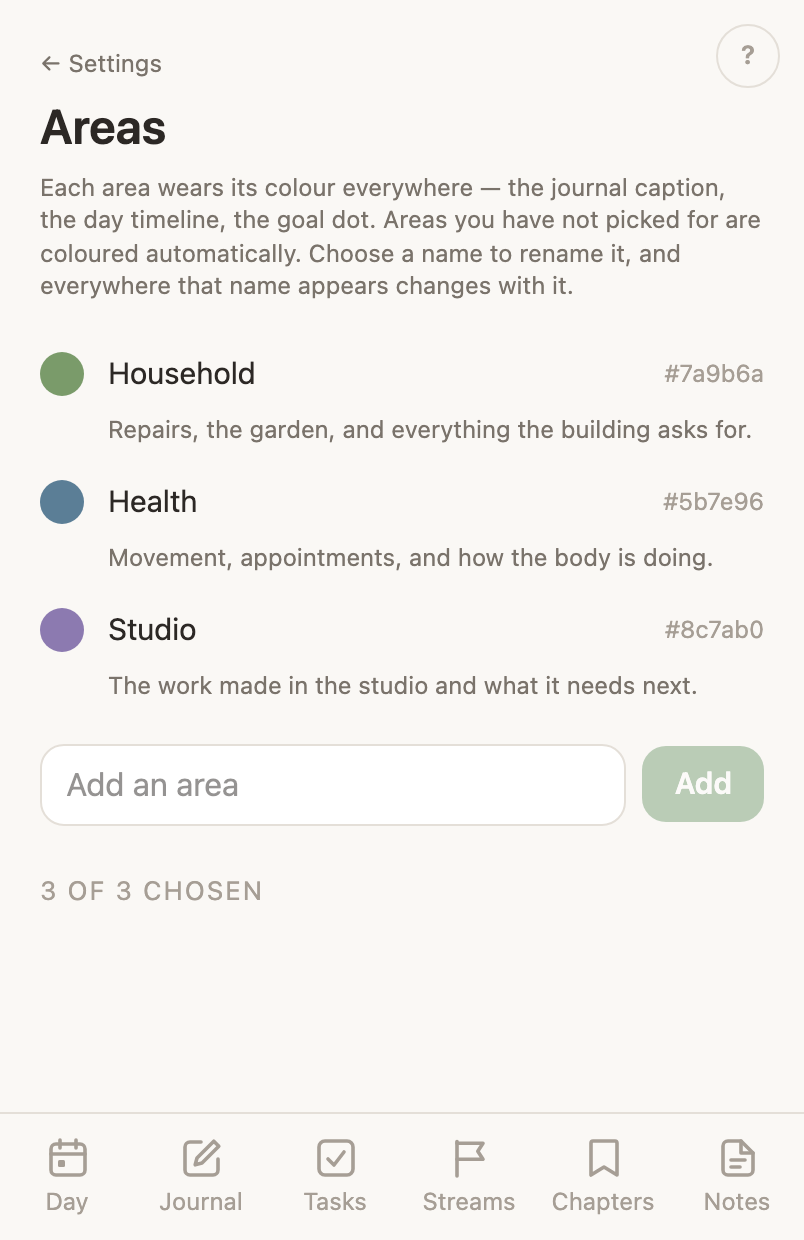
Add a life area, rename it and the new name shows everywhere, and pick its colour from thirteen or leave it Automatic.
A life area is renamed, never deleted
Renaming fixes a typo everywhere at once. Removing a life area would unfile every task and entry under it with no way back, so a life area has no delete anywhere.
The AI switches
One switch turns every AI job off for you alone, and under it each job has a switch of its own. Each row says what that job does and exactly what it sends when it runs. Five jobs are on the page: area naming, task filing, document filing, transcribing a recording, and what changed in a version. A job that has not been built has no switch here.
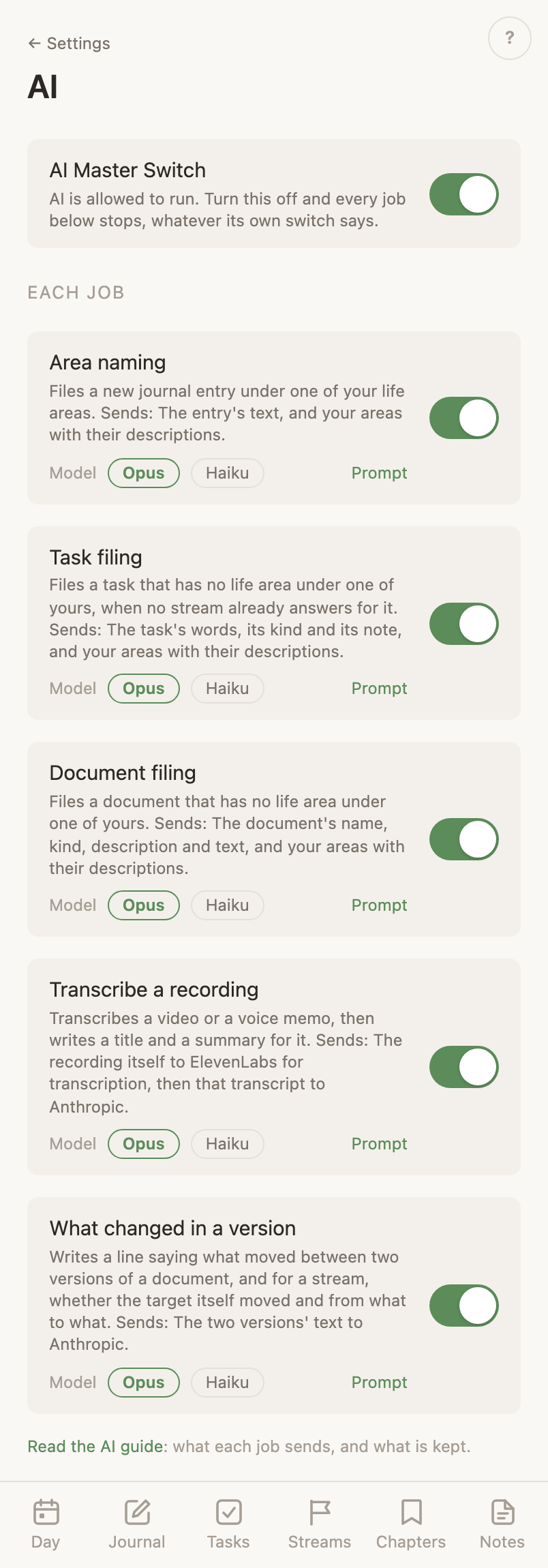
The model and the prompt on each AI job
Every job names its model choices under its description, Opus or Haiku, as two pills with the one in use marked. What each model trades is written as a browser tooltip on its pill, so it appears on hover on a laptop and not at all on a phone. Prompt beside them opens the words the job runs on in a box you can edit and save. Those words are the ones written into the app until you change them, and your version is what the job uses from then on. A job whose prompt takes inputs says which markers have to stay in the text.
When the whole instance has AI off
Your LifeOps can be run with the AI off entirely, in which case there is nothing to choose. The web says so in place of the switches. Off is a supported way to run this app: entries save with no life area filled in, documents keep their history without summaries, and no control breaks.
Your statuses
Statuses are your own words, in four fixed groups the app reads. Each one has a colour and a sentence saying what it means to you. Open, Done and Cancel keep their names because the app looks for them by name. Everything else you can rename.
Where a deleted status sends its tasks
A status nothing uses deletes on the spot. One still in use will not delete until you pick the status its rows move to, and it says how many tasks and how many streams those are. Both move together.
Streams & task detail
One switch adds the deeper task system, meaning statuses, types, the extra views and the fuller sheet, and on the web it fills in the Streams page. Turning it off destroys nothing. The tasks keep their statuses and types, and the simple list stops showing them.
Set a reminder
Settings › Reminders opens a composer: what to remind you to do, the day, the time, and how often. A task’s own menu has Remind me as well, which starts one about that task. A reminder’s time is never the task’s due date.
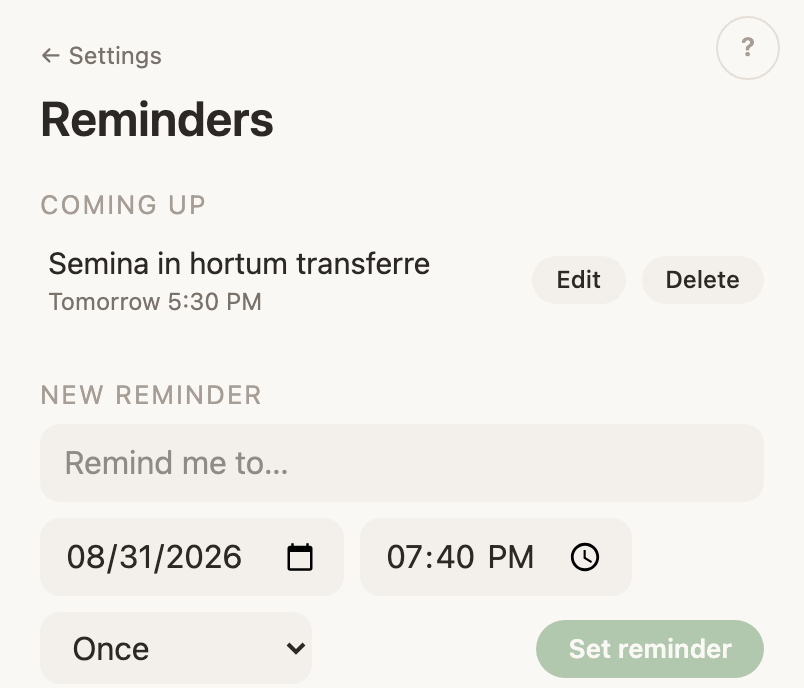
Repeat a reminder
A reminder comes back every day, every weekday, or every week. The next time is worked out from the wall clock each time it fires, so a repeat survives travel and the clocks changing.
The reminders you have set
Coming up, under the composer, lists every reminder you have set, soonest first, each with when it is due and how often it comes back.
Answer or snooze a reminder
A reminder that has gone off offers Done and Snooze 15 min on its own row, with an hour and Delete behind them. It stays there until you answer it.
A reminder reaches your phone
A reminder you set arrives as a notification on your phone at its time. Setting the first one asks your phone for permission to send them.
The sleep switch
One switch turns the morning sleep reading off, if you do not want the entry at all. Readings already in your journal stay: a switch is not a delete.
Download your whole account
One file on the web holds every entry, task, document, setting, photo and attachment in your account. It is a plain download, made without sending anything anywhere.
The off-site copy
Your Data names the day this account was last copied off the server, or says plainly that no copy is kept, or that the check itself failed. Those are three different sentences and it never collapses them into one.
A way out, not a way between
The download is a copy you keep. Loading one back into a LifeOps is not built, and the screen says so rather than leaving you to find out.
The guides
The ? in the corner of every web screen opens this app’s own manual, on the page for the screen you are looking at. The guides open even when you are signed out. The phone app has no ? yet.
The Development page
Development, at the bottom of Settings, shows what is being built for your LifeOps and the checks running behind it: the work in flight, the work waiting on you, and each standing check with the last time it ran. It reads live rows rather than describing a process.
Sign out of your account
Sign out on the web ends the session. On the phone it also clears the address and the token, so the app has to be connected again. Both ask twice.
Written for youThe app writes rows you never typed
Each entry the app writes names what wrote it. You correct the sleep reading and your Claude’s entries the way you correct your own; the Day’s System and Changes rows open to be read and nothing else.
The sleep reading
Each morning the app works out your night from the traces you left and posts it as a journal entry, one line: when you woke, how long you slept, and the time it has you falling asleep. When the end had to be inferred the line says so instead, giving the waking as a limit and the span as an upper bound. What it read to get there is on the entry, not in that sentence. You correct it like anything you wrote, and the sleep switch turns the whole thing off.
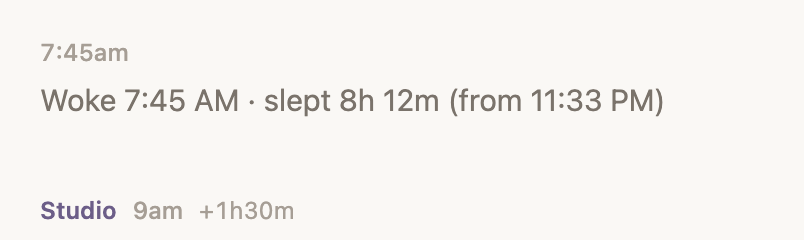
The morning with no reading
Some mornings there is not enough to go on: too few traces, or no gap that looks like a night between three and fourteen hours. The app writes no entry at all rather than a number nobody can stand behind.
A corrected night stays corrected
Once you fix a night by hand, the next morning’s run leaves it alone. Your number is the one that stands.
Device signals
A charger, the home Wi-Fi, CarPlay, and a computer gone idle are each recorded as a small Signal row, and the sleep reading uses them as proof. Each takes a small setup on its device, done by whoever runs your LifeOps.
A meeting becomes a task
Calendar events arrive as tasks, typed as meetings. Completing one writes a time log over the hours it was scheduled for, which you can then correct. A meeting with no end time logs without one.
A task becomes a calendar event
It goes the other way too: a task with a date is written into your calendar as a real event, and edits follow it. Whoever runs your LifeOps connects the calendar for now.
Deleting the meeting cancels the task
An event you remove from your calendar leaves its task cancelled rather than gone, so the record of what was planned survives the change of plan.
Change records
Making, deleting or shelving one of your things leaves a row in the Day’s Changes column at the minute it happened. Tasks, streams, documents and chapters all write one, and so does a change to a task’s status or any of a stream’s fields, with the value it left and the one it took. Meeting decisions show up the same way: Done and Decline close the meeting’s task, and going to one of two overlapping meetings leaves a row for the one stood down. A row for something you deleted keeps the record and drops the link: there is no page left to open.
File an entry under a life area
An entry saved without a life area gets one from the AI, which is sent the entry’s text and your life areas with the descriptions you wrote for them, nothing else. It is one of the AI’s jobs, with its own switch, and with it off the entry saves with no area filled in.
Session notes
This one is not built yet. Editing a document writes nothing to your Journal today: the changes save into the document as you write, and the document itself is the record. A note about each editing session is planned as one of the AI’s jobs, with its own switch when it is built.
A document keeps its earlier versions
A document holds its current text and the versions it passed through. Saving replaces what is on screen and the earlier states stay readable behind the history panel. The raw autosave trail runs underneath as the crash net, folded away and shown one row per sitting when you ask for it, so a long afternoon of writing reads as one stretch rather than forty saves. The sentence saying what changed between two versions is written by an AI job you can switch off.
Agent rows
Entries marked Agent were written for you by your Claude: a conversation logged, a note taken on your behalf, or a line it spoke out loud. A device signal is not an Agent row. That is a machine reporting, not something deciding what to write.
Search skips the app’s own rows
Journal search returns what you wrote. The rows the app keeps for itself stay out of the results, so looking for a word finds your words.
Recurring tasks
A task that repeats is recreated on its schedule as a fresh task, so finishing this week’s does not touch next week’s. Setting up the repetition is a job for whoever runs your LifeOps, for now.
What happens once a day
Once a day the app copies its whole database, and keeps the recent days’ copies plus one a week further back. None of it needs you awake, and none of it writes into your journal.